Recently, Lois Tweneboa Kodua, a Postdoctoral Fellow of SPA and member of CWAS , published her research titled "Driving Green Innovation: Unlocking Strategies for Effective Green Human Resource Management Implementation in Ghana" in the Journal SAGE Open .
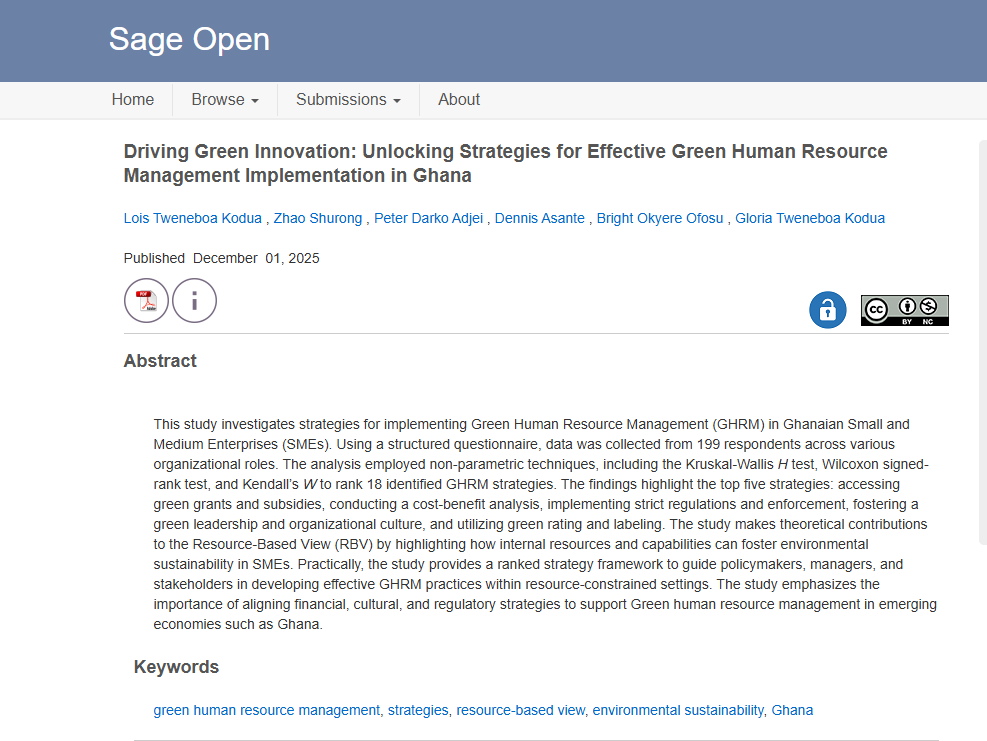
DOI: https://doi.org/10.1177/21582440251398621
See the link for the full text:https://doi.org/10.1177/21582440251398621
1.Abstract
This study investigates strategies for implementing Green Human Resource Management (GHRM) in Ghanaian Small and Medium Enterprises (SMEs). Using a structured questionnaire, data was collected from 199 respondents across various organizational roles. The analysis employed non-parametric techniques, including the Kruskal-Wallis H test, Wilcoxon signed-rank test, and Kendall’s W to rank 18 identified GHRM strategies. The findings highlight the top five strategies: accessing green grants and subsidies, conducting a cost-benefit analysis, implementing strict regulations and enforcement, fostering a green leadership and organizational culture, and utilizing green rating and labelling. The study makes theoretical contributions to the Resource-Based View (RBV) by highlighting how internal resources and capabilities can foster environmental sustainability in SMEs. Practically, the study provides a ranked strategy framework to guide policymakers, managers, and stakeholders in developing effective GHRM practices within resource-constrained settings. The study emphasizes the importance of aligning financial, cultural, and regulatory strategies to support Green human resource management in emerging economies such as Ghana.
2.Keywords
green human resource management, strategies, resource-based view, environmental sustainability, Ghana
3.Research Methodology
Strategy Formulation:First, a systematic literature review was conducted across databases including Scopus, Web of Science, and Google Scholar to identify 15 initial GHRM strategies. Then, 3 additional strategies (opportunities to participate in green programs, corporate environmental communication strategies, top management support) were supplemented based on the opinions of 5 GHRM experts with over 10 years of experience in Ghana, forming a total of 18 strategies.
Questionnaire Design and Distribution:A three-part questionnaire (introduction, demographic questions, 18 GHRM strategy importance evaluation items with a 7-point Likert scale) was developed. After pilot testing and revision, snowball sampling was adopted to distribute 250 questionnaires to SMEs in hospitality, manufacturing, construction, health, and agribusiness sectors in Ghana, with 199 valid responses (response rate of 79.6%). The respondents covered 8 roles including general employees (28%), HR managers (21%), and operations officers (15%).
Data Analysis Methods:
Normality Test: Shapiro-Wilk test was used to confirm the non-normal distribution of data (all p-values = 0.00 < 0.05).
Descriptive Statistics: Mean and standard deviation were applied to rank the importance of strategies.
Non-parametric Tests: Kruskal-Wallis H test for inter-group comparison, Wilcoxon signed-rank test for variable comparison, and Kendall’s W test for ranking consistency analysis (Kendall’s W = 0.574, p < 0.001, indicating moderate consensus among groups).
Factor Analysis: Exploratory Factor Analysis (EFA) with KMO = 0.970 and significant Bartlett’s test (p = 0.000) was conducted to classify 18 strategies into three thematic dimensions, explaining 82.916% of total variance.
4.Research Content
Theoretical Foundation:The study is based on the Resource-Based View (RBV), which argues that internal resources (e.g., green leadership, employee commitment, environmental culture) are core drivers of organizational environmental performance and competitive advantage, especially suitable for resource-constrained SMEs in developing countries.
Current Status of GHRM in Ghanaian SMEs:SMEs in Ghana (defined as firms with 6-99 employees and assets ≤ US$100,000) account for over 90% of total enterprises, but face problems such as insufficient GHRM implementation, limited resources, and lack of institutional support, while under increasing stakeholder pressure to adopt sustainable practices.
Ranking and Classification of GHRM Strategies:
Top 5 Strategies: accessing green grants and subsidies (ST5, mean=5.30), cost-benefit analysis (ST9, mean=5.30), strict rules and enforcement (ST7, mean=5.26), green leadership and organizational culture (ST10, mean=5.23), green rating and labeling (ST4, mean=5.18).
Three Thematic Dimensions (via EFA):
Capacity Building and Advocacy: including corporate environmental awareness programs, training programs, policy development and integration, etc.
Incentives and Support: including green employee rewards, green program participation opportunities, R&D, green grants access, etc.
Governance and Regulatory Frameworks: including green ambassador deals, strict regulations, monitoring, cost-benefit analysis, green leadership culture, etc.
Inter-group Perception Differences
Operations officers (OP) generally rated GHRM strategies lower than other roles (e.g., HR, finance, health and safety). The largest perception gap was found in "support from top management" between account managers and operations officers (diff=2.63), mainly due to OP’s focus on immediate operational priorities and disconnect from strategic sustainability planning.
5.Conclusion and discussion
Conclusion:Financial support (accessing green grants) and evaluative mechanisms (cost-benefit analysis) are the most critical for GHRM implementation in Ghanaian SMEs, followed by regulatory constraints and cultural leadership. Formal training programs were the least valued (mean=4.50) due to resource constraints and disconnect from operational priorities.
Theoretical Contribution:The study extends the RBV theory by verifying that internal resources (financial planning, cultural alignment, regulatory systems) of SMEs in resource-constrained contexts can drive environmental sustainability and form competitive advantages, breaking reliance on external resources. It also expands RBV’s applicability from financial capital to intangible assets such as organizational culture and normative systems in SME contexts.
Practical Implications:For Ghanaian SMEs, it is necessary to prioritize financial and regulatory-based GHRM strategies, adopt integrated training methods (e.g., peer learning) instead of formal training, and strengthen cross-functional communication to align operational and strategic perspectives on sustainability. The ranked strategy framework helps SMEs allocate limited resources to high-impact practices.
Limitations and Future Research:Limitations include subjective respondent attitudes, small sample size, and selection bias from snowball sampling. Future research can expand samples with stratified random sampling, explore regional differences in GHRM strategies, and conduct longitudinal studies to verify the long-term impact of strategy implementation.
This paper was completed by Lois Tweneboa Kodua under the guidance of Professor Zhao Shurong. It has been included in the Journal SAGE Open (ISSN:2158-2440). This study was supported by the Sichuan Social Science Planned Key Research Project (SCJ23ND61), the 2022 Central Chinese University Fundamental Research Program for Humanities and Social Science Cultivation Key Project (No. ZYGX2022FRJH004).






 Address:Qingshui River Campus: No. 2006 West source road, Chengdu high tech Zone (West District)
 Code: 611731
 E-mail: cwasuestc@163.com
 Tel: 0086-028-61831756/61831706
 Fax: 0086-028-61831756/61831706