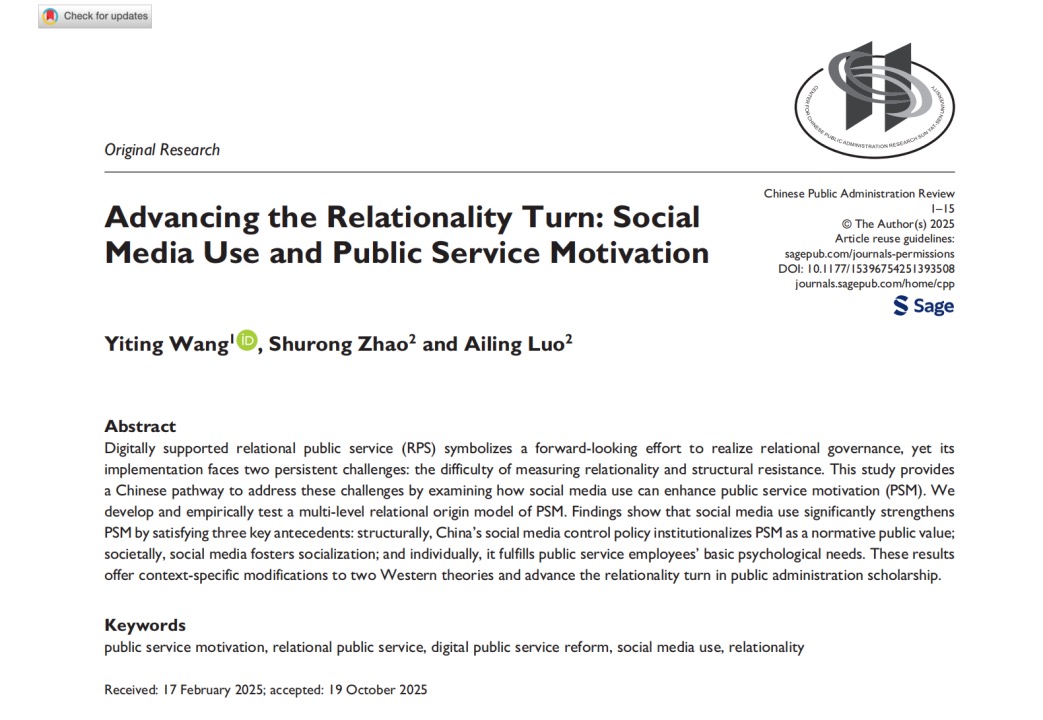
Title: Advancing the Relationality Turn: Social Media Use and Public Service Motivation
DOI: https://doi.org/10.1177/15396754251393508
See the link for the full text: https://doi.org/10.1177/15396754251393508
Abstract
Digitally supported relational public service (RPS) symbolizes a forward-looking effort to realize relational governance, yet its implementation faces two persistent challenges: the difficulty of measuring relationality and structural resistance. This study provides a Chinese pathway to address these challenges by examining how social media use can enhance public service motivation (PSM). We develop and empirically test a multi-level relational origin model of PSM. Findings show that social media use significantly strengthens PSM by satisfying three key antecedents: structurally, China’s social media control policy institutionalizes PSM as a normative public value; societally, social media fosters socialization; and individually, it fulfills public service employees’ basic psychological needs. These results offer context-specific modifications to two Western theories and advance the relationality turn in public administration scholarship.
Key Words
Public Service Motivation, Relational Public Service, Digital Public Service Reform, Social Media Use, Relationality
Research Methodology
The initial analysis employs an Ordinary Least Squares (OLS) model with province and time fixed effects, clustering standard errors at the provincial level to address within-province correlation. To improve the robustness of our causal inference, we further apply propensity score matching.
Findings
This study outlines an implementation pathway for digitally supported RPS in China, focusing on how social media can enhance PSM among public service employees (PSEs). Our findings highlight the multi-level relational origin of PSM:
(1) At the macro level, social media control policies reflect structural relational shaping.
(2) At the meso level, social media facilitates politicized socialization.
(3) At the micro level, social media use satisfies individuals’ needs for competence and relatedness.
(4) Therefore, social media use significantly enhances PSM among PSEs, demonstrating the relational nature of PSM.
Policy Recommendations
The study provides three key policy recommendations to promote PSM:
(1) State social media policy combines regulation and control tool with high-quality knowledge resources and interactive platforms that enhance legitimacy and understanding.
(2) Social media platform could not only conform to state-led policies by disseminating PSM-related content to shape the information environment, but also foster group support and emotional cohesion through online communities, shared experiences, and peer reinforcement.
(3) PSEs can actively use social media to access information that clarifies the scientific and legitimate foundations of PSM and engage in online interactions that provide social support and foster belonging.





 Address:Qingshui River Campus: No. 2006 West source road, Chengdu high tech Zone (West District)
 Code: 611731
 E-mail: cwasuestc@163.com
 Tel: 0086-028-61831756/61831706
 Fax: 0086-028-61831756/61831706