Editor's Note: Tea is a vibrant carrier of China's millennia-old cultural heritage, a cultural symbol that transcends mountains and seas, and a gentle bond that connects hearts. When international students from Africa step onto the tea gardens of Hongya, Sichuan, touch the tender green tea buds with their fingertips, and inhale the delicate fragrance of tea, a journey of culture, growth, and resonance quietly begins on this mild spring day. This seemingly simple experience of tea culture has long surpassed mere "learning": it puts the students' philosophy of "I come, I learn, I grow" into practice, transforms the connection between China and Africa from abstract concepts into tangible experiences, and brings mutual understanding between different cultures down to a single cup of tea and shared moments. As the students have realized, tea is not merely a beverage but also a medium of communication across languages, a spiritual anchor embodying sustenance and warmth, and a cultural symbol that blends traditional depth with innovative vitality.
Hongya Tea Culture Experience Deepens International Students’ Understanding of Cultural Exchange and Shared Development
BY NYABOGA DOUGLAS MOCHAMA(Student Id : 202524160217, Country : Kenya)

Rain drifted gently across the tea-covered hills of Hongya in Sichuan Province on a quiet Sunday afternoon. April in Hongya arrives beautifully wet, wrapping the terraces in soft layers of green. The ground beneath their feet was damp, while the air carried the fresh, nostalgic, and calming scent of tea leaves.
Among the endless rows of tea plants, international students carefully followed the guidance of local farmers, learning the delicate technique of selecting one bud with one leaf. The act appeared simple at first glance, yet within the silence of the fields, it revealed something deeper—a small gesture connecting human hands to centuries of tradition, patience, and discipline.
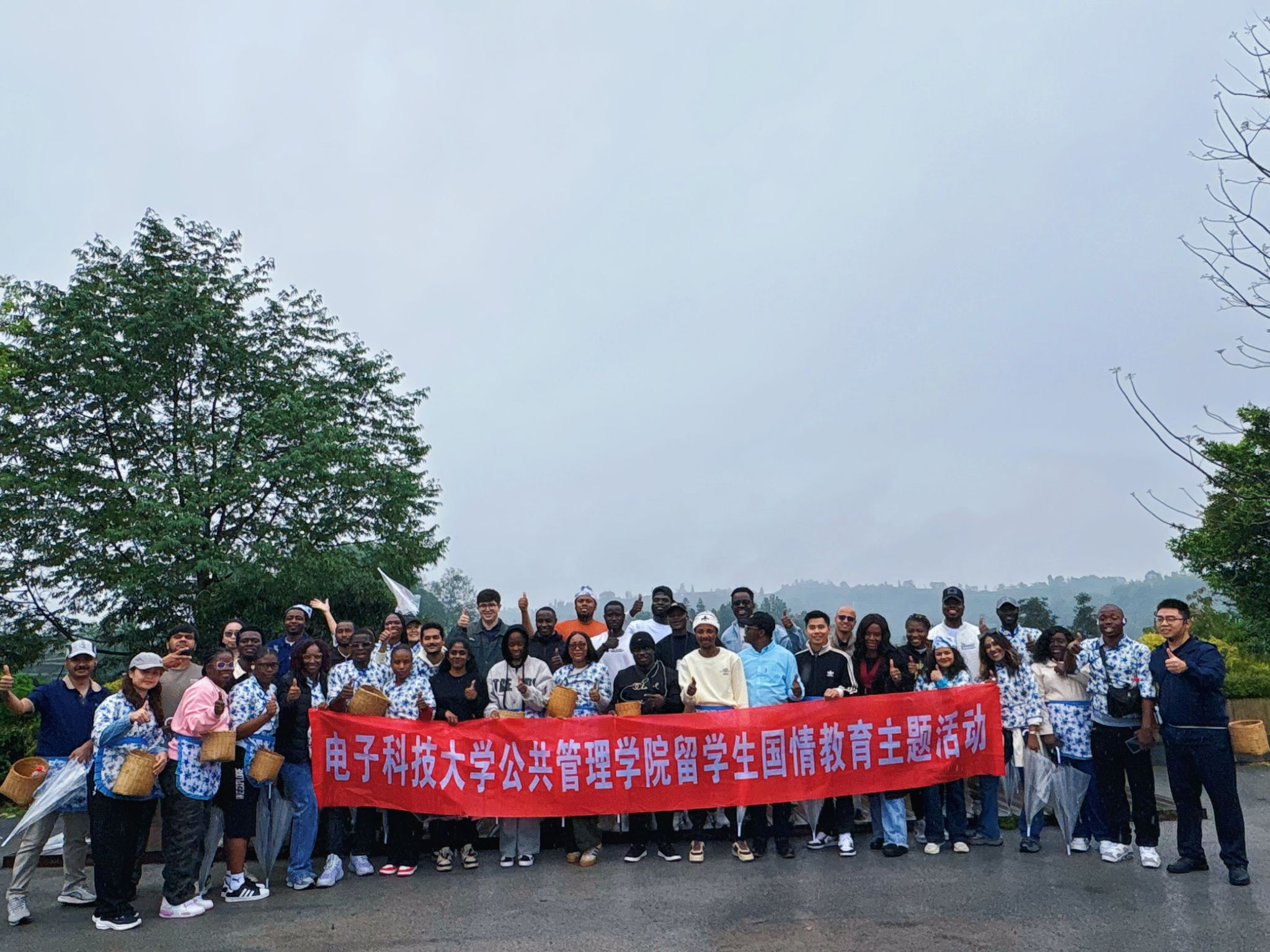
The visit formed part of China’s “Perception of China” programme organized for international students at the School of Public Administration of the University of Electronic Science and Technology of China (UESTC). Beyond the classroom, the activity offered students an opportunity to experience the cultural, agricultural, and human stories rooted within Chinese tea culture while reflecting the spirit of the UESTC international student motto: “I Come, I Learn, I Grow.”
In nearby processing workshops, the learning continued. A master tea maker stood beside a heated wok, carefully turning fresh leaves by hand. With every practiced movement, raw greenery slowly transformed into finished tea—a visual reminder that tradition is preserved not only through history, but through people, experience, and dedication passed across generations.
For many students, the experience became more than a cultural excursion. It became a moment of reflection on identity, growth, and shared human connection.
“The experience goes beyond tea production,” remarked Blandina, an international student from Malawi. “Tea becomes a lens through which identity, heritage, and human connection are appreciated.”
For Douglas, an international student from Kenya, the fragrance of the tea fields carried his thoughts thousands of kilometers away to the rolling plains of Kericho—Kenya. Watching the process unfold in Hongya reminded him of his father carefully picking tea leaves by hand and placing them into a woven basket carried on his back.
“That is how my education was funded,” he reflected quietly while observing the processed tea leaves.
The moment revealed an unexpected connection between China and Kenya—two countries where tea remains deeply tied to livelihoods, memory, and everyday life. In Kenya, regions such as Kericho and Nandi Hills continue to produce tea for global markets through large-scale farming and strict quality standards. Yet beyond economics, tea remains deeply personal: shared in homes each morning, offered to guests as a gesture of hospitality, and woven into moments that linger in memory for years. Observing tea culture in China highlighted a universal truth for many of the students: although landscapes, languages, and traditions may differ, the bond between people and tea continues to endure across cultures.
Across the plantations and workshops, conversations also turned toward the future of tea farming. Students discussed challenges related to sustainability, climate change, and evolving global markets. Communities in both China and Kenya continue exploring ways to preserve long-standing traditions while embracing innovation and modern agricultural practices. In this way, resilience and creativity remain essential ingredients in every cup of tea.
Beyond the farms and factories, tea revealed another role—quiet, yet powerful. During cultural exchange activities in Hongya, students from different countries gathered around cups of tea, sharing stories, laughter, and experiences. Conversations flowed naturally, even when language barriers occasionally appeared.
In those moments, tea stopped being a subject of study and became a shared experience—a simple bridge between people, and a language of friendship, brotherhood, and mutual understanding.
The experience further reflected the broader vision of international education promoted through initiatives supported by the People’s Republic of China, including programs under the China Scholarship Council and the Chinese Government Scholarship. Through study, research, and cultural exchange at institutions such as UESTC, international students continue building academic knowledge while strengthening connections across nations and cultures.
In Hongya, learning extended far beyond classrooms and textbooks. Connections abroad became lived rather than abstract. For many students, the experience demonstrated that understanding between cultures often begins not through grand declarations, but through something simple: a shared moment, a shared space, and a cup of tea.
Introduction to the Hongya Rural Revitalization Social Practice and Cultural Experience Base of the University of Electronic Science and Technology of China:
The Hongya Rural Revitalization Social Practice and Cultural Experience Base is a national-level practice platform jointly established by the University of Electronic Science and Technology of China and Hongya County. Designated as a 2025 "Perceiving China" practice base by the China Scholarship Council, the base aims to help international students gain a deep understanding of China's rural development achievements, traditional culture, and social governance models through rural revitalization practices, traditional cultural experiences, and grassroots governance research, thereby cultivating international talents who understand and appreciate China while promoting cultural exchange and mutual learning between China and other countries. This base marks the first time the University of Electronic Science and Technology of China has been selected as a "Perceiving China" practice base, and it is also the first local project in Hongya to be incorporated into the national social practice platform for international students. Through an innovative approach combining "immersive experiences and interactive exchanges," students transition from merely "seeing China" to "doing China" and "understanding China," gaining a comprehensive perception of contemporary China's development trajectory and the charm of Chinese culture. The base serves as a practical platform for effectively telling China's stories and amplifying its voice globally.






 Address:Qingshui River Campus: No. 2006 West source road, Chengdu high tech Zone (West District)
 Code: 611731
 E-mail: cwasuestc@163.com
 Tel: 0086-028-61831756/61831706
 Fax: 0086-028-61831756/61831706