Leaves of Connection: ‘How Hongya Tea Taught Me the Taste of Shared Development
Author: Josiah Emmanuel Student ID: 202524160123
Tea as a Bridge
It was just dawn, and we were a group of international students from the School of Public Administration at the University of Electronic Sc ience and Technology of China (UESTC) in the Qinshuihe Campus when we got together, our backpacks packed and our expectations alive. We came from all over the world, from Sierra Leone, Nigeria, Ghana, Uganda, Botswana, Malawi, Pakistan, etc., strangers but with a common goal of acquiring knowledge on public administration, but still strangers to the depths of Chinese culture beyond the books and classroom discussions. It was no ordinary field trip, but one organized by our school to make the concepts of cultural exchange and shared development a purveyor of real practice and sensation to the theoretical learning in the classroom, and we set out as a group in one of the university buses, heading for Hongya County in Sichuan Province.
It was morning when the cityscape of Chengdu had faded, giving way to a rainy weather that was softened by a light mist. The conversation of my coursemates, about speculating on tea picking, on the importance of agriculture in rural redevelopment, subsided into silence as we drove through the tiny country lanes, and I grew in wonder. I'm thinking back to the distance from modern classrooms at UESTC's Qingshuihe Campus, analysing policy frameworks and development models, to this ancient land of tea; from my home country of Sierra Leone, where cocoa and rice shape the lives of communities; to these slopes where tea has been grown for two millennia. In ‘Overview of China' taught by Professor Li Hongliang, we had dug through case studies of Cultural Dimensions of rural development in China, but nothing could have been more convincing than seeing the freshly-picked tea leaves drifting in through the window, the rhythmic rustling of the bamboo baskets of the farmer, and the quiet grace of a tradition passed down through generations. This is no research article, but a story of discovery, of tearing down the barriers and the bridges created by a single day and a group of students at Hongya County's tea farm with the international students of UESTC.This is not only a research report, but it is also a story of discovery, of breaking down barriers and building bridges with a group of students from Hongya County's tea farm, and international students from UESTC.
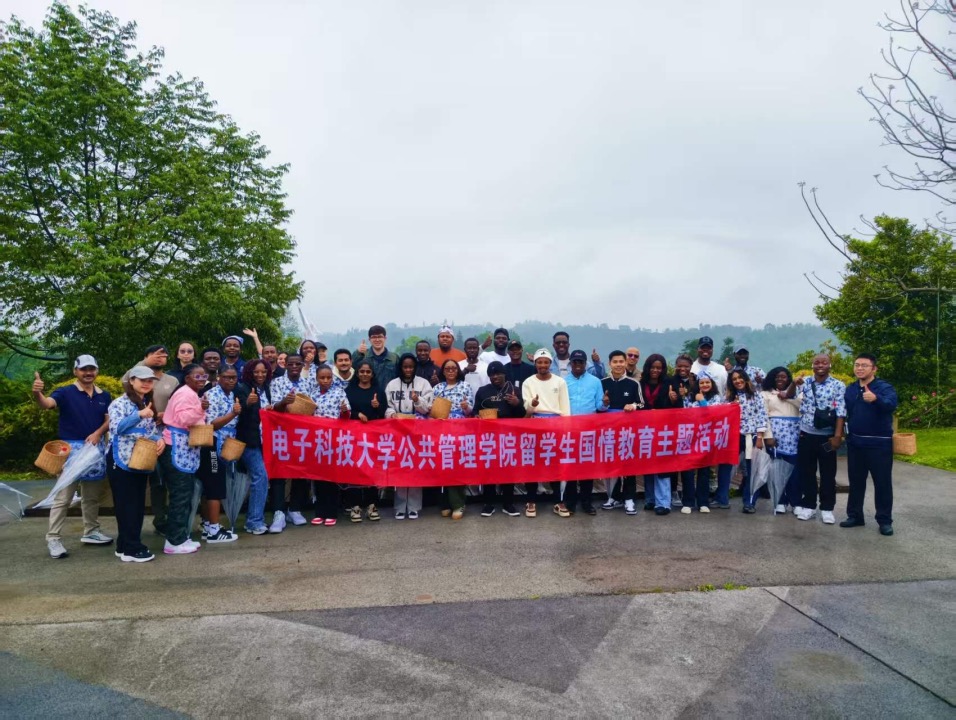
The Roots of Hongya: Tea as Living Heritage
Tea is not just a trade for Hongya County, it's a way of life. While we were being guided through the Tea Garden, a female staff member told us about the history of tea, which began in the Spring and Autumn Period when tea grew wild in these mountains. “Lu Yu commented on Hongya in the Classic of Tea, which was compiled in the 8th century,” she said, referring to the book compiled by the Chinese scholar. Tea was more than a drink to him: it was a symbol of balance between people and nature in this area. I walked through the rows of tea bushes, and clinging to the hillside were the gnarled roots, and the weight of history came down upon me. Carefully plucked one by one, each leaf told the tales of generations: the farmers who had cultivated these fields for centuries, the traders who had transported the tea to Tibet via the Tea Horse Road, and the communities who had made tea a part of their daily existence.
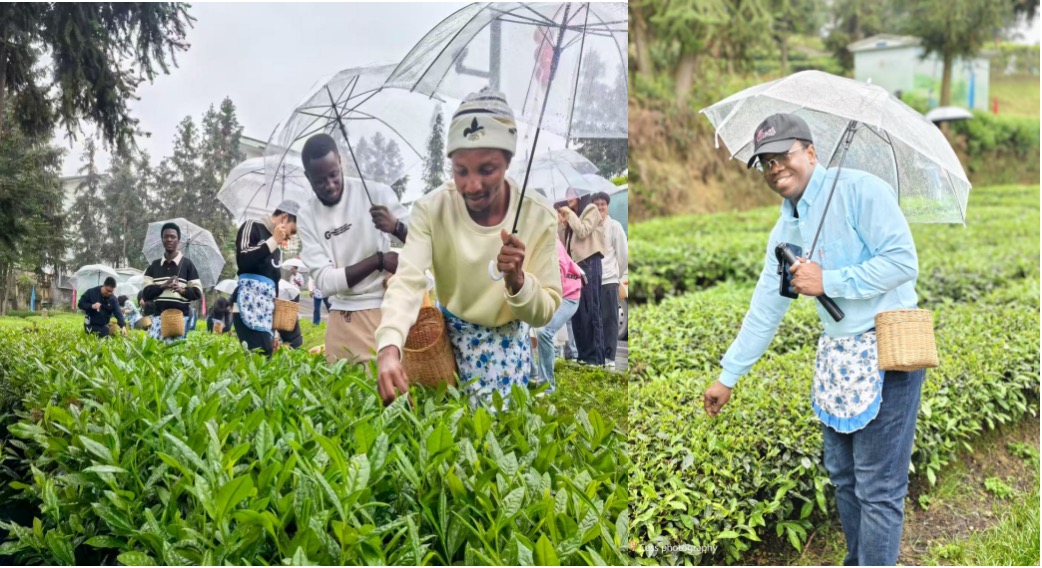
In Sierra Leone, our agricultural heritage is also related to our identity. Rice, cocoa, and palm oil are not only crops but symbols of community – handed down through families and honored in festivals. I remembered how my grandmother taught me to pick the cocoa pods in our village, and Mr. Wanji, our energetic school coordinator, demonstrated to us how to pick out the perfect bud (two leaves and a tip, he said, referring to his hands). The gestures varied, but the intent was the same: to honor the land, keep traditions alive, and impart knowledge. That instant, the gap between Sierra Leone and China closed. They weren't opposites, but variations on a theme: people and the products that sustain them: tea and cocoa, hills and valleys.
Hands-On: The Labor of Connection
The heart of the visit lay in participation. “To understand tea, you must pick it,” Mr. Wanji told us, handing me a small bamboo basket. I followed Mr. Wangji’s lead, bending low to pluck the tenderest leaves, my fingers brushing against the cool, waxy surface. At first, I fumbled, snapping stems, missing buds, but he gently corrected me: “Not with force. With patience.” As the morning wore on, my movements became more fluid, and I fell into rhythm with the other students. Their baskets filled faster than mine, but they never hurried me. Instead, they chatted, gesturing and laughing, and Mr. Wanji shared stories and memories of harvests past, and expressed pride in the tea that had lifted Honya County out of poverty.
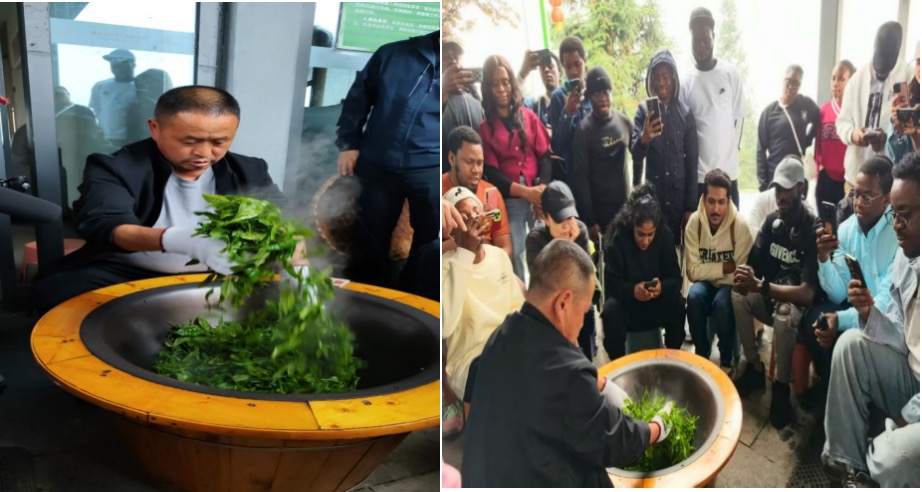
After picking, we followed our guide, the female staff, to the processing shed, where modern machines stood alongside traditional woks. A gentle old tea maker demonstrated the art of roasting. “Temperature is everything,” he said, tossing the leaves in an iron wok over an electrical connection. The air filled with a rich, nutty fragrance as the moisture evaporated, and he explained how different roasting times produced different flavors, light and floral for green tea, deep and smoky for black. Watching him, I thought of the women in my village who roast cocoa beans over open fires, their hands moving in a dance of precision. The techniques were distinct, but the dedication to craft was identical. This was not just labour; it was creativity, a way of infusing a product with the maker's soul.
By noon, my back ached, but I felt a sense of accomplishment that no textbook could provide. I had not just learned about tea production; I had participated in it. The theory of experiential learning, which I had studied in class, came to life: concrete experience (picking leaves) led to reflective observation (watching the tea maker roast), which gave way to abstract conceptualization (understanding the link between labour and cultural identity). But more than that, I had connected with people. When one of the female staff offered me a cup of freshly brewed tea, strong, earthy, and slightly sweet, I tasted not just the leaves, but her generosity, her expertise, and her love for her land.
Shared Development: Tea as a Catalyst for Community
As a public administration student, I arrived in Hongya with a curiosity about how traditional agriculture could drive modern development. What I found was a model of shared prosperity that felt both innovative and deeply rooted in community. Over lunch, Mr. Wanji explained Hongya’s “Three Teas Coordination” strategy: integrating tea culture, industry, and technology to lift rural communities out of poverty. “Twenty years ago, many young people left for the cities,” he said. “Now, they are coming back. The tea industry provides jobs, the cultural tourism brings income, and the cooperatives ensure that everyone benefits.”
Hongya’s success is tangible. The county’s tea plantations cover 20,000 hectares, supporting over 100,000 residents and generating a comprehensive output value of over 6 billion yuan. But numbers alone do not tell the story. What impressed me most was the emphasis on inclusion. Smallholder farmers, who make up the majority of tea producers, are organized into cooperatives that provide technical training, access to markets, and fair prices. The Tea Garden, which hosts thousands of tourists annually, employs residents as guides and craftspeople. “We don’t just sell tea,” a female staff member said. “We sell an experience, and that experience belongs to the whole community.”
In Sierra Leone, we face similar challenges: smallholder farmers struggling to access markets, youth leaving rural areas for cities, and a need to leverage our agricultural heritage for development. As I listened to her speak, I thought of how our cocoa and coffee industries could benefit from a similar approach. Imagine, I thought, Sierra Leonean villages hosting tourists to learn about cocoa farming, cooperatives ensuring farmers get a fair share of the profits, and young people returning to build businesses around our traditional crops. Hongya’s model is not a blueprint to copy, but a source of inspiration: development that honours tradition, empowers communities, and leaves no one behind. This is the essence of shared development, not just economic growth, but growth that is inclusive, sustainable, and rooted in cultural identity.
Cross-Cultural Dialogue: Tea Ceremonies and Shared Values
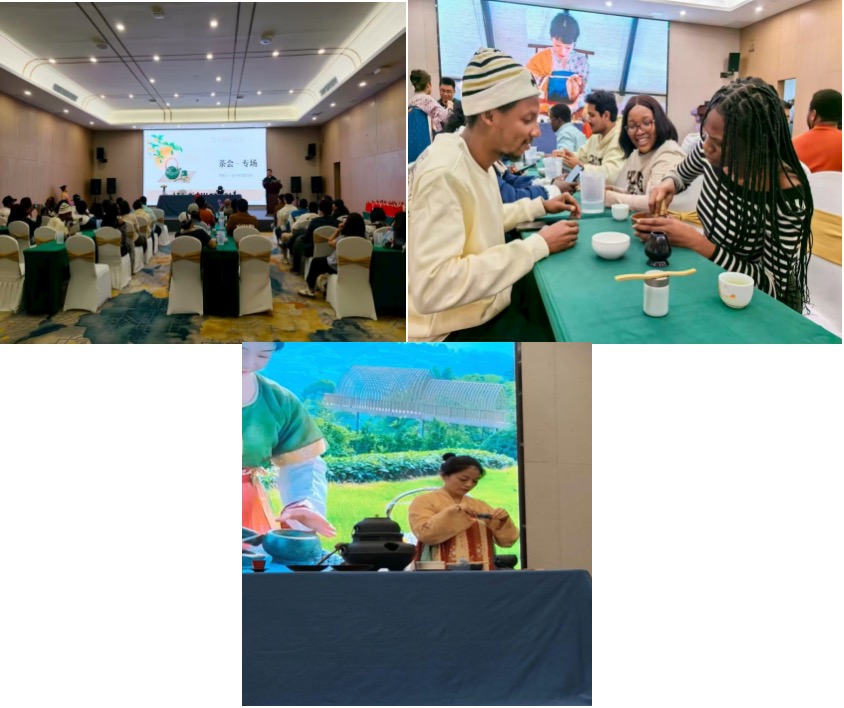
The afternoon brought a tea ceremony, held in a small hall overlooking the tea gardens. Female staff members dressed in a traditional cheongsam led us through the rituals: warming the teapot, rinsing the cups, and steeping the leaves with water. “The tea ceremony is about more than drinking tea,” they explained. “It is about presence, being fully in the moment with others.” As they poured the amber liquid into tiny cups, the room fell silent. I sipped slowly, savouring the delicate flavour, and looked around at my colleagues, international scholars. For a few minutes, we spoke no words, but we communicated through the shared experience of taste, aroma, and quiet respect.
In Sierra Leone, our version of this is the “kola nut ceremony,” a ritual of hospitality where kola nuts are shared to symbolize peace and friendship. When we welcome guests, we offer kola nuts with the words, “A kola nut is not eaten alone.” The tea ceremony, I realized, was a Chinese expression of the same value: that connection is forged through shared rituals, not just conversation. As they explained the philosophy of “harmony” (hé) that underpins the ceremony, harmony between humans, between nature, and between cultures, I thought of how often cultural exchange is reduced to surface-level interactions: trying new food, visiting landmarks, speaking a few words of another language. But true exchange, I realized, is deeper. It is about recognizing the values that unite us: hospitality, respect, and a desire to connect.
Reflections: Beyond the Tea Garden
As we left Hongya County, the mist had lifted, and the setting sun painted the hills in gold. A sachet of tea leaves, carefully packed, was bought by our school Coordinator, Mr. Wanji, and the real souvenirs were intangible: the memory of the tea craftsman’s hand, the taste of freshly roasted tea, and the realization that cultural exchange is not an abstract concept, but a lived experience. In my public administration studies, I had learned about “soft power” and “mutual benefit,” but in Hongya, I saw those theories made flesh. Tea was not just a product; it was a bridge between past and present, between individuals, and between nations.
For Sierra Leone, the lessons of Hongya are clear. Our agricultural heritage is a treasure, not a relic. By investing in cooperatives, promoting cultural tourism, and preserving traditional knowledge, we can transform crops like cocoa and rice into drivers of inclusive development. But more than that, we can build bridges with countries like China, bridges rooted not just in economic cooperation, but in mutual respect and understanding.
In Hongya County, I learned that development is not just about economic growth, but about preserving the things that make us human, our traditions, our connections to the land, and our ability to connect. As I returned to my university, the taste of Hongya tea still lingering on my tongue, I thought of the words of a female staff member spoken that morning: “Tea teaches us that harmony is not about being the same, but about respecting our differences.” In a world divided by conflict and misunderstanding, those words feel more important than ever.
As Sierra Leone and China continue to deepen their partnership, I hope that we can embrace this spirit of shared experience.
“Let us trade not just goods, but stories. Let us learn not just from textbooks, but from each other’s fields and villages. And let us remember that the path to shared development begins with a single cup of tea, of cocoa, of understanding.”






 Address:Qingshui River Campus: No. 2006 West source road, Chengdu high tech Zone (West District)
 Code: 611731
 E-mail: cwasuestc@163.com
 Tel: 0086-028-61831756/61831706
 Fax: 0086-028-61831756/61831706