There was a time when I believed hunters were heroes.
Growing up in the small village of Gaye-Pue Woe in central Liberia, I admired my father more than anyone else. He was strong, fearless, and able to provide for our family when times were hardest. To me, he was a man who could survive anything.
What I did not understand then was that survival sometimes comes at a cost.
Today, as a master's student in China reflecting on a visit to Panda Valley in Sichuan Province, I realize how much my understanding of wildlife, nature, and humanity has changed. This transformation began many years ago with an unlikely teacher—an orphaned baby baboon named Mbartoe.
A Childhood in the Shadow of War
Liberia's civil war, which lasted from 1989 to 2003, changed countless lives, including my family's.
Before the conflict, my father had a stable life in the city. But when war erupted, he lost everything—his home, his job, and his savings. With few opportunities available and a family to feed, he returned to our village and turned to hunting.
What began as a means of survival soon became his livelihood.
Week after week, he ventured deep into the forest, returning with animals that were sold at local markets. Over the years, he became widely known throughout the region. People no longer called him Arthur Ziah. They called him "Ziah the Hunter".
As a young boy, I was proud of him.
I saw the animals he brought home as proof of his strength and determination. Hunting seemed normal. It was part of life. It was how families survived.
Then everything changed.
Meeting Mbartoe
In 2004, my father returned home carrying something unusual.
It was not a carcass destined for the market. It was a frightened infant baboon.
I named him Mbartoe, a word in my local dialect that means "my best friend".
At first, Mbartoe was simply a pet. But as the months passed, he became much more than that. He became a member of our family.
He played with us, followed us around, and shared our daily lives. He had his own personality, his own emotions, and his own way of communicating. The more time I spent with him, the more I began to see animals differently.
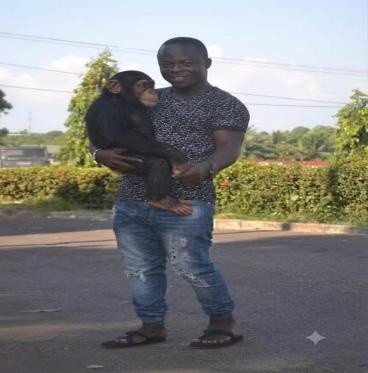
For the first time, I realized that wildlife was not just something living in the forest. Animals could form bonds, feel fear, seek comfort, and show affection.
Every time my father returned from hunting, I found myself thinking about Mbartoe.
If this little baboon could become part of our family, what about the animals we never got to know?
The question stayed with me.
A Change of Heart
Mbartoe did not only change me.
He changed my father as well.
Over time, the man once feared by wildlife began to see animals through a different lens. He often sat quietly watching Mbartoe interact with our family. Slowly, his attitude softened.
One day, he made a remarkable admission.
He told us he would never kill a baboon or monkey again.
For a hunter whose identity had become tied to the forest, this was a significant step. It did not end his hunting immediately, but it marked the beginning of a transformation.
Sadly, after spending eight years with our family, Mbartoe passed away following a brief illness.
His absence left a void in our home, but his impact remained.
He had planted a seed of compassion that would continue to grow.
From Hunter to Farmer
As peace gradually returned to Liberia, conservation awareness also increased.
Government agencies, local communities, and conservation organizations worked to educate people about the importance of protecting wildlife and preserving ecosystems.
In 2005, my father made a life-changing decision.
He put down his hunting tools and picked up farming equipment. The man once known as "Ziah the Hunter" became a farmer.
Today, he manages one of the largest cash-crop farms in our region. Looking back, he often says that animals feel pain just as humans do. If they could speak, he believes they would ask for the same right to live that we claim for ourselves.
His journey taught me an important lesson: true strength is not found in taking life, but in protecting it.
A New Chapter in China
Years later, another journey began.
In 2025, I traveled thousands of miles from Liberia to China to pursue my master's degree at the University of Electronic Science and Technology of China (UESTC) in Chengdu.
Before arriving, I had read about Sichuan Province—its mountains, rivers, technology industries, agricultural achievements, and world-famous giant pandas.
I learned that the giant panda is one of China's most cherished national symbols and one of the world's greatest conservation success stories.
Yet reading about conservation and witnessing it are two very different experiences.
The Day Panda Valley Taught Me a Lesson
On June 7, 2026, our coordinator, Mr. Lucky Wang of the School of Public Administration, organized a visit to Panda Valley.
Nothing could have prepared me for what I saw.
The pandas appeared peaceful and healthy. Their habitats were clean, spacious, and carefully maintained. Visitors moved through the park with admiration and respect, eager to learn about conservation rather than exploit nature.
As I watched the pandas resting among the greenery, my thoughts drifted back to Liberia. I remembered the forests of my childhood.
I remembered my father.
Most of all, I remembered Mbartoe.
Standing there, thousands of miles from home, I realized that the lessons of conservation are universal. Whether in the bamboo forests of Sichuan or the rainforests of Liberia, wildlife depends on human choices.
When people choose protection over destruction, nature flourishes.
When people choose stewardship over exploitation, future generations benefit.
China's success with panda conservation demonstrates what is possible when a nation commits itself to preserving its natural heritage.

Carrying the Lesson Home
Before we left Panda Valley, Mr. Wang shared the story of China's efforts to protect the giant panda and restore its habitat.
His words stayed with me long after the visit ended.
As I took photographs and videos, I knew I was collecting more than memories. I was gathering lessons to take home.
I look forward to sharing these experiences with my father and my community. I want them to see what I saw: a world where humans and wildlife can coexist, where conservation is not an obstacle to development but a partner in it.
The responsibility now belongs to my generation.
We must build bridges between knowledge and action, between conservation and community development, and between today's choices and tomorrow's future.
Conclusion
When I was a child, I believed hunters were heroes.
Today, I believe heroes are those who protect what cannot protect itself.
An orphaned baboon named Mbartoe taught me that every life has value. My father's transformation from hunter to farmer taught me that people can change. And Panda Valley showed me what is possible when compassion is combined with commitment.
The forests of Liberia and the bamboo mountains of Sichuan may be separated by continents, cultures, and languages, but they share a common truth: nature survives when people choose to care.
That is Mbartoeıs legacy.
And it is a legacy worth carrying forward.






 Address:Qingshui River Campus: No. 2006 West source road, Chengdu high tech Zone (West District)
 Code: 611731
 E-mail: cwasuestc@163.com
 Tel: 0086-028-61831756/61831706
 Fax: 0086-028-61831756/61831706