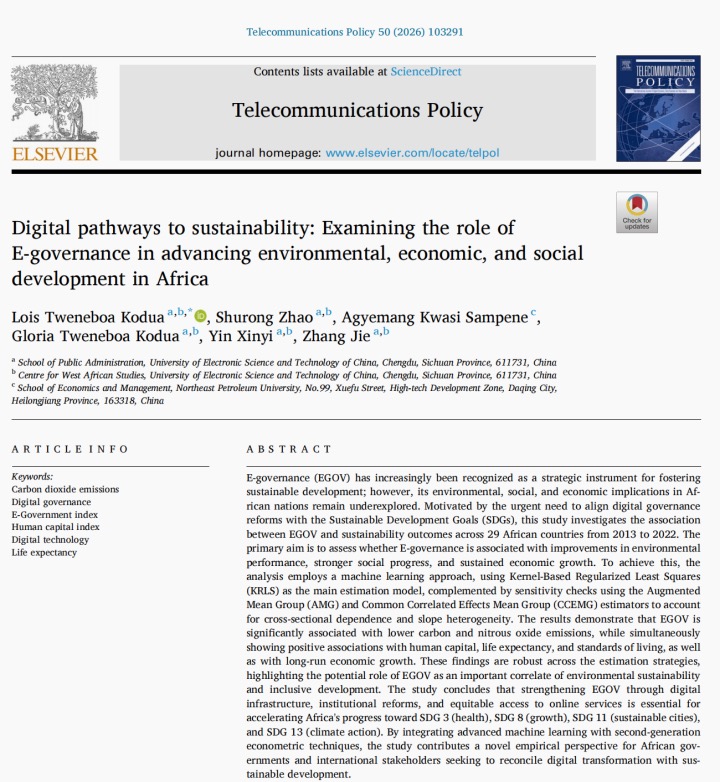
Title:Digital pathways to sustainability: Examining the role of E-governance in advancing environmental, economic, and social development in Africa
IF:6.5(2026)SSCI Q1
DOI:https://doi.org/10.1016/j.telpol.2026.103291
See the link for the full text:https://doi.org/10.1016/j.telpol.2026.103291
Abstract
E-governance (EGOV) has increasingly been recognized as a strategic instrument for fostering sustainable development; however, its environmental, social, and economic implications in African nations remain underexplored. Motivated by the urgent need to align digital governance reforms with the Sustainable Development Goals (SDGs), this study investigates the association between EGOV and sustainability outcomes across 29 African countries from 2013 to 2022. The primary aim is to assess whether E-governance is associated with improvements in environmental performance, stronger social progress, and sustained economic growth. To achieve this, the analysis employs a machine learning approach, using Kernel-Based Regularized Least Squares (KRLS) as the main estimation model, complemented by sensitivity checks using the Augmented Mean Group (AMG) and Common Correlated Effects Mean Group (CCEMG) estimators to account for cross-sectional dependence and slope heterogeneity. The results demonstrate that EGOV is significantly associated with lower carbon and nitrous oxide emissions, while simultaneously showing positive associations with human capital, life expectancy, and standards of living, as well as with long-run economic growth. These findings are robust across the estimation strategies, highlighting the potential role of EGOV as an important correlate of environmental sustainability and inclusive development. The study concludes that strengthening EGOV through digital infrastructure, institutional reforms, and equitable access to online services is essential for accelerating Africa's progress toward SDG 3 (health), SDG 8 (growth), SDG 11 (sustainable cities), and SDG 13 (climate action). By integrating advanced machine learning with second-generation econometric techniques, the study contributes a novel empirical perspective for African governments and international stakeholders seeking to reconcile digital transformation with sustainable development.
Keywords
Carbon dioxide emissions, Digital governance, E-Government index, Human capital index, Digital technology, Life expectancy
Edited by Zhang Jie&Xu Qianwen






 Address:Qingshui River Campus: No. 2006 West source road, Chengdu high tech Zone (West District)
 Code: 611731
 E-mail: cwasuestc@163.com
 Tel: 0086-028-61831756/61831706
 Fax: 0086-028-61831756/61831706