Title: Why do you reveal? Perceived organizational motives of instrumental and image-enhancement orientations on employee transparency efforts in E-commerce
Journal: Journal of Psychology in Africa (SSCI paper)
DOI: https://doi.org/10.32604/jpa.2026.076434
Full-text link: https://www.techscience.com/jpa/online/detail/27744
Abstract
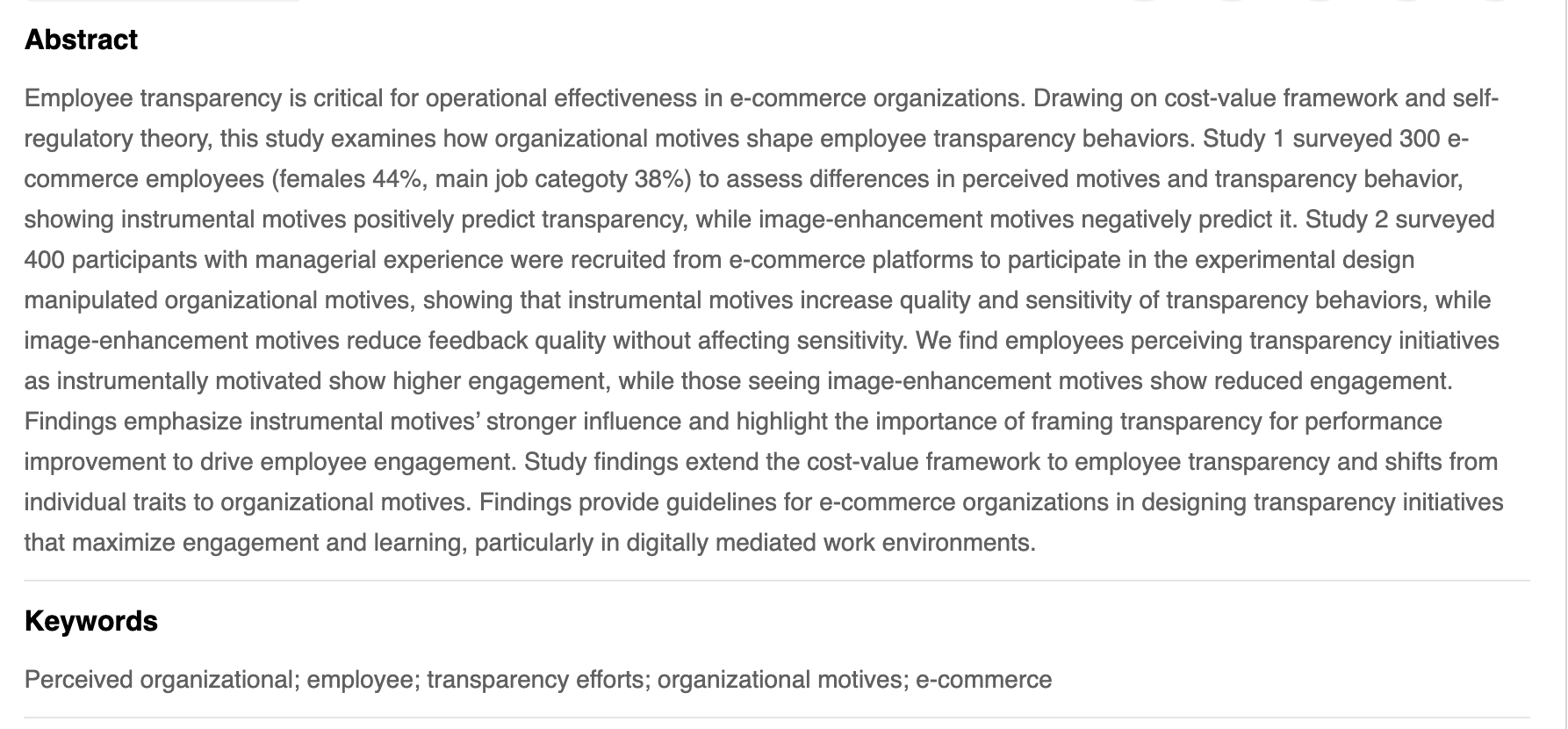
Drawing on the cost-value framework and self-regulatory theory, this paper investigates how perceived organizational motives of instrumental orientation and image-enhancement orientation influence employee transparency efforts within e-commerce settings. Two separate studies were implemented for empirical validation. Study 1 surveyed 300 e-commerce employees; the results indicate that perceived instrumental organizational motives positively predict employee transparency efforts, while perceived image-enhancement organizational motives exert a negative predictive effect on such behaviours. Study 2 adopted a scenario-based experiment with 400 participants holding managerial-related work experience. It reveals that instrumental motives improve both the quality and sensitivity of employee transparency efforts, whereas image-enhancement motives only reduce feedback quality without significant influence on sensitivity. The findings suggest that employees are more willing to engage in transparency practices when they interpret such initiatives as instrumental measures for business improvement; by contrast, their willingness drops if transparency is merely viewed as an image-building tactic. This research extends the cost-value framework to the domain of employee transparency behaviours, shifting research focus from individual traits to perceived organizational motives, and delivers practical managerial implications for e-commerce organisations to design transparency-related institutional arrangements and motivate employee participation under digital contexts.
Keywords: Perceived organizational motives; employee; transparency efforts; e-commerce
This paper was completed by Paschal Jao under the guidance of Professor Zhao Shurong (Center for West African Studies, University of Electronic Science and Technology of China)
Edited by Xu Qianwen






 Address:Qingshui River Campus: No. 2006 West source road, Chengdu high tech Zone (West District)
 Code: 611731
 E-mail: cwasuestc@163.com
 Tel: 0086-028-61831756/61831706
 Fax: 0086-028-61831756/61831706