Editor’s Note: The year 2026 marks the 70th anniversary of the establishment of China‑Africa diplomatic relations
and the China‑Africa Year of People‑to‑People and Cultural Exchanges. The 2026 Ghana Governance Training Programme
is one of the 2026 China‑Africa people‑to‑people and cultural exchange series hosted by the Center for West African
Studies of UESTC. Co‑organised by the Center for West African Studies of UESTC and the UESTC Base for Sichuan
Provincial Cadre Education and Training, the programme targets participants from Ghanaian universities and local
public administration authorities. It features a series of special classroom teaching sessions to share China’s
practical experience in governance, promote mutual learning between China and Ghana, and deepen China‑Africa
people‑to‑people and cultural exchanges. A roster of distinguished scholars from the university are invited to
deliver lectures, offering multi‑dimensional professional insights for Ghanaian participants.
From September 24 to October 2, the 2026 Ghana Governance Training Programme took place at the Shahe Campus of the
University of Electronic Science and Technology of China (UESTC). Following the spirit of President Xi Jinping’s
congratulatory letter to the opening ceremony of the 2026 China‑Africa Year of People‑to‑People and Cultural Exchanges,
the programme delivered special classroom teaching focusing on digital smart governance. Professor Wu Min, Doctoral Supervisor,
was invited to give a special lecture titled Digital Governance Empowering Public Education Services: China’s Experience,
China‑Africa Cooperation and Localized Pathways for Ghana. For Ghanaian public officials and university learners in education
and public administration sectors, she systematically elaborated the theoretical logic of digital technologies empowering public
education services, China’s practical experience, China‑Africa cooperation cases, and explored education digitalisation
transformation pathways tailored to Ghana’s national conditions.
Professor Wu Min holds a PhD in Management. She is a Professor and Doctoral Supervisor. She is also the Director of the Institute
for Public Affairs Research at Sichuan University and the Vice President of the Chengdu Science Communication Association.
Her main research areas include public policy analysis and evaluation, economics of education and technological innovation,
and human resources and social security. She has led and completed multiple national‑level, provincial/ministerial‑level
research projects as well as several horizontal research projects. She has published numerous academic papers in domestic
and international journals and has authored three academic monographs. She has received several awards including the award
for Outstanding Teacher of Sichuan University, the Second Prize for Outstanding Research Achievements in the National School
Communist Youth League, the Third Prize for Outstanding Achievements in Philosophy and Social Sciences of Sichuan Province,
the First Prize for Outstanding Research Achievements from the Sichuan Association for Degree and Graduate Education, the
Second Prize for Teaching Achievements of Sichuan University, the Emerald/IACMR Chinese Management Research Fund Award, and
the Citation of Excellence, among other honors and awards.
Adopting a framework of “theoretical instruction — policy comparison — case analysis — group discussion”, this course
consists of two teaching units interspersed with Q&A sessions and thematic seminars, balancing theoretical interpretation,
case analysis and localized critical thinking. Drawing on her long‑term research in digital public governance and education
digitalisation, Professor Wu analysed the underlying logic of digital education transformation from a public governance
perspective, providing actionable references for Ghana to improve public education services and narrow regional education gaps.
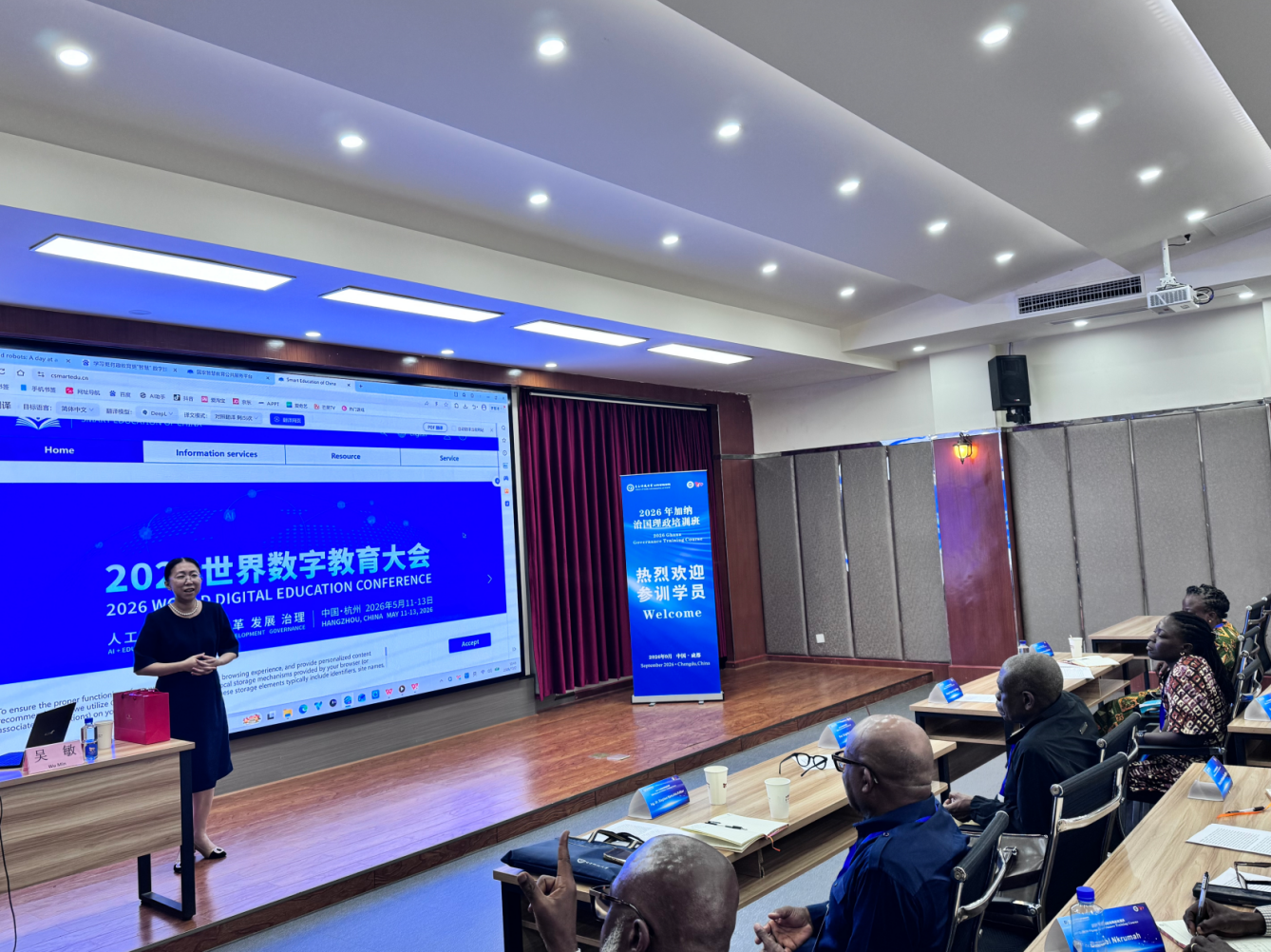
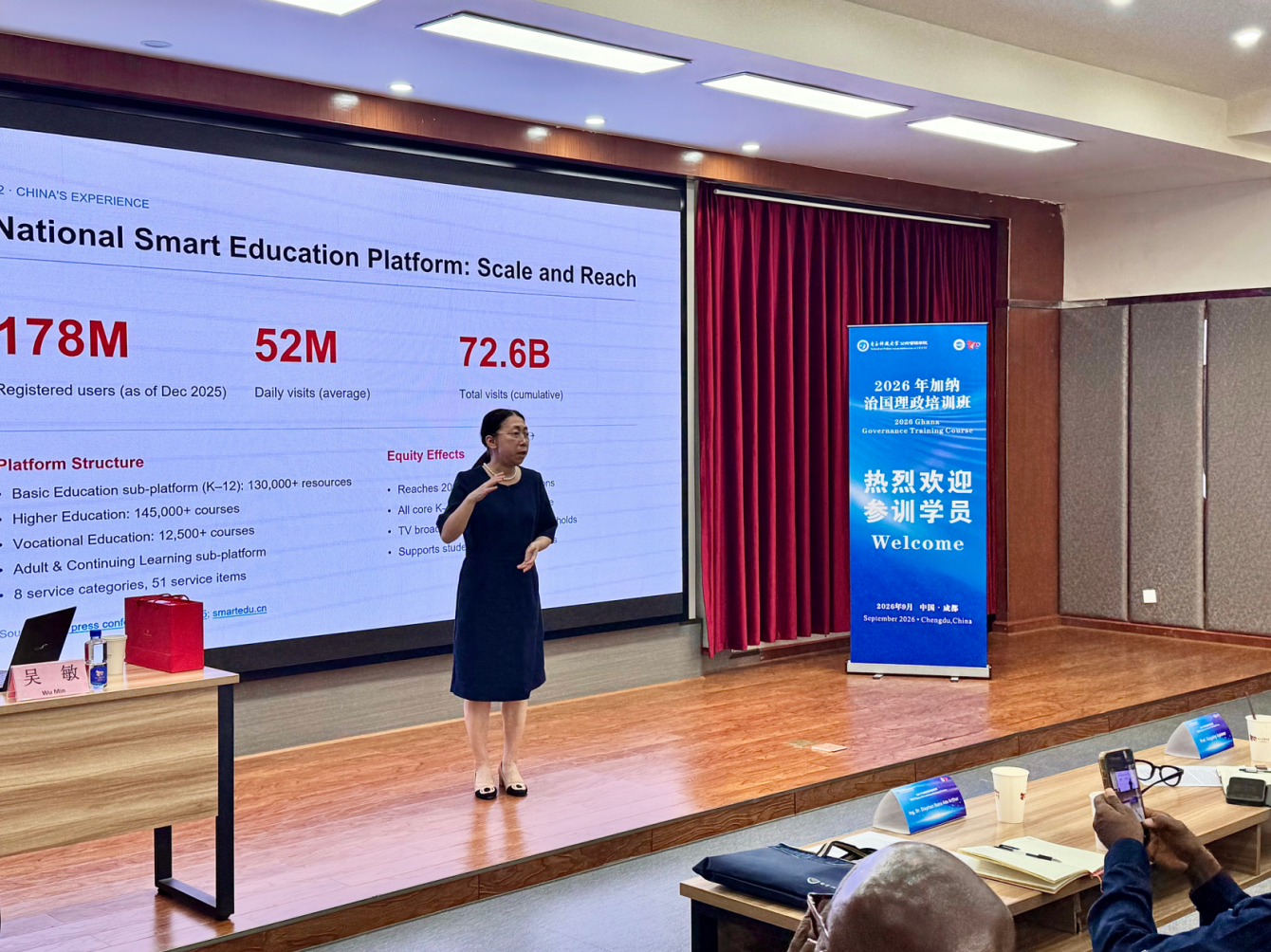
Teaching by Prof. Wu in the classroom
The first unit of classroom teaching focuses on the theoretical framework and China’s practical experience of digital
governance empowering public education services. It clarifies two core dimensions of digital public governance in education:
first, transforming the supply of public education services with digital technologies. Relying on national public education
platforms, education big data and AI adaptive learning tools, high‑quality educational resources can flow across regions,
learning conditions can be intelligently monitored, and one‑stop handling of education livelihood services can be realised.
Second, governing the digital transformation of education itself. Supporting systems covering data security, digital ethics,
platform regulation, digital inclusion and education equity should be established to guard against risks such as the digital
divide, algorithmic bias and exclusion of vulnerable groups.
The course outlined the three‑stage evolution of global education digitalisation: early education informatisation and
equipment digitalisation, the construction of online education and educational platforms, and the current new phase of digital
education governance oriented toward public value. It systematically reviewed key milestones of China’s national education
digitalisation strategy, interpreted the development of the National Smart Education Platform, the national education digitalisation
initiative and policies related to “AI + Education”. It also introduced arrangements for digitalisation of public education
services in the Overall Layout Plan for Digital China Construction. The lecture illustrated China’s governance approach of
connecting high‑quality urban and rural educational resources via platforms to boost balanced basic education and improve
teachers’ capacity.
In the case presentation section, the course showcased typical Chinese practices: the National Smart Education Public Service
Platform, Squirrel AI adaptive classrooms, Hangzhou Smart Education City Platform, and county‑level digital education support
projects. It objectively analysed the effects of digital technologies in reducing teachers’ lesson preparation burden,
compensating for the shortage of rural teachers and enabling personalised training. Meanwhile, it emphasised that technology
is only a tool. Human actors remain responsible for education evaluation, educational objectives and education accountability.
Digital construction must balance balanced education development and uphold the bottom line of education equity.
The course also carried out horizontal comparison of international policies. It introduced the African Union Continental
Artificial Intelligence Strategy and global education digitalisation agendas of UNESCO, and compared regulatory rules of
the EU AI Act in education scenarios. Based on the overall education landscape of the African continent, it highlighted the
strengths and practical constraints for Ghana’s education digitalisation transformation, including uneven urban and rural
internet access, insufficient total teachers, inadequate digital literacy among educators, unstable power supply in rural
areas and limited penetration of digital devices among students. It warned against simply copying digital solutions developed
in advanced economies.
The second unit focuses on existing China‑Africa digital education cooperation practices and localized transformation pathways
for Ghana, addressing cutting‑edge issues of education digitalisation in developing countries. The course sorted out existing
outcomes of China‑Africa digital education cooperation, introducing the China‑Africa Regional Center for Digital Education,
China‑Ghana joint development projects of digital education resources, and pragmatic cooperation cases between China and Ghana
in teacher digital competency training, localized teaching resource development and smart classroom pilots. It proposed that
when promoting education digitalisation, developing countries should pay more attention to public governance indicators such
as resource accessibility, benefits for rural students, improvement of teachers’ digital capabilities, operational
sustainability and gender equity.
Professor Wu Min noted that the localisation of digital education cannot simply transplant foreign technologies and platforms.
To advance education digitalisation, Ghana needs to base its efforts on local learning contexts, local languages and local
curriculum content, prioritise infrastructure improvement and carry out pilot construction in phases. It is vital to attach
importance to digital inclusion, guarantee digital access for rural students, girls and vulnerable groups, and avoid new education
gaps brought by technology. Artificial intelligence can be leveraged to empower education governance and explore human‑machine
collaborative teaching models while preserving the humanistic essence and ethical boundaries of education.
Participants engaged in lively discussions during group seminars. Ghanaian learners had in‑depth exchanges on topics including
pilot digitalisation programmes for rural schools in Ghana, digital development of local teaching resources, construction of
teacher digital literacy training systems, long‑term funding guarantee for digital education, approaches to narrowing urban‑rural
and gender‑based digital education divides, and pathways for low‑cost and sustainable smart classroom development. Raising
realistic questions based on local education administration, university teaching practices and digital transformation in Ghana,
participants fully exchanged views. One participant mentioned that the course broke the misconception of “technology supremacy”.
They recognised that the core goal of digital education is to advance equity in national education, and they will consider feasible
plans for small‑scale pilots and phased promotion in light of local conditions.
At the end of the session, Professor Wu Min concluded that empowering public education services through digital governance
represents a long‑term and progressive public governance reform, with education equity and educational value as its ultimate
goals. For Ghana, digital transformation should prioritise local needs and pilot implementation. It shall first address core
pain points including resource sharing and teacher capacity building, develop a low‑cost, maintainable and sustainable digital
education system, keep humans at the centre of technology application and ensure technology benefits people.
This course falls under the “Digital Smart Governance” module of the training programme. Upholding the positioning of mutual
learning between China and Africa, it integrates China’s practical experience in digital public governance of education with
the realities of education development in West African countries. It broadens Ghanaian participants’ horizons on digital
education governance and lays a foundation for continued dialogue and pragmatic cooperation between China and Ghana in digital
education, teacher development and public education services. Although the training programme has concluded, exchanges and
dialogue between the two sides on education digitalisation and public education service governance will continue to deepen.
Text by CWAS team
Photos by Xupeifeng, Luohongquan
Edited by Zhangruiheng
Contributed by: School of Public Administration & Center for West African Studies of UESTC, University of Electronic Scienceand Technology of China






 Address:Qingshui River Campus: No. 2006 West source road, Chengdu high tech Zone (West District)
 Code: 611731
 E-mail: cwasuestc@163.com
 Tel: 0086-028-61831756/61831706
 Fax: 0086-028-61831756/61831706