Editor’s Note: The year 2026 marks the 70th anniversary of the establishment of China-Africa diplomatic relations and the
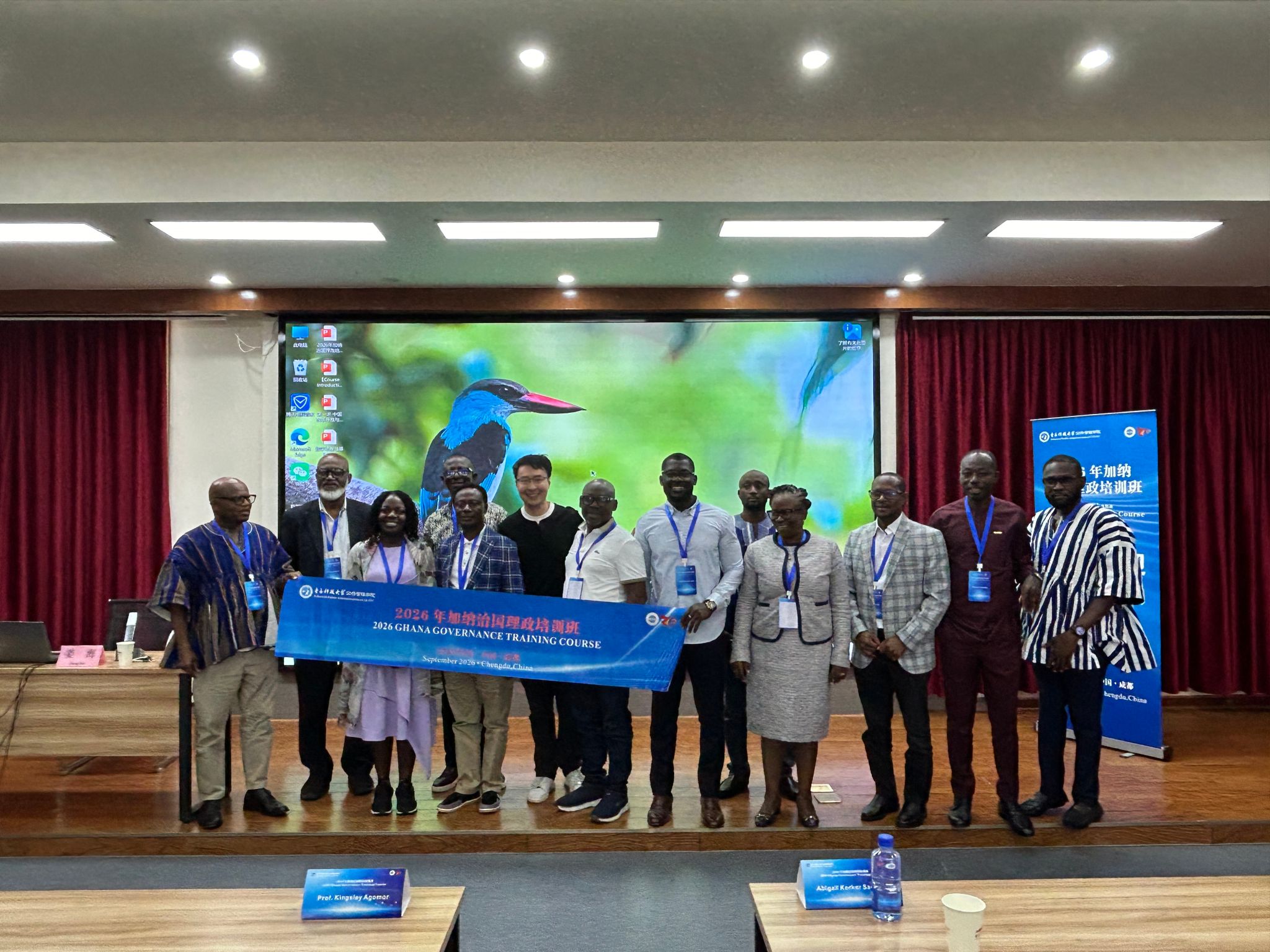
China-Africa Year of People-to-People and Cultural Exchanges. The 2026 Ghana Governance Training Programme is one of the 2026
China-Africa people-to-people and cultural exchange series hosted by the Center for West African Studies of UESTC. Co-organised
by the Center for West African Studies of UESTC and the UESTC Base for Sichuan Provincial Cadre Education and Training, the
programme targets participants from Ghanaian universities and local public administration authorities. It features a series of
special classroom teaching sessions to share China’s practical experience in governance, promote mutual learning between China
and Ghana, and deepen China-Africa people-to-people and cultural exchanges. A roster of distinguished scholars from the university
are invited to deliver lectures, offering multi-dimensional professional insights for Ghanaian participants.
From September 24 to October 2, the 2026 Ghana Governance Training Programme was held at the Shahe Campus of the University of
Electronic Science and Technology of China (UESTC). Following the spirit of President Xi Jinping’s congratulatory letter to the
opening ceremony of the 2026 China-Africa Year of People-to-People and Cultural Exchanges, the programme arranged a series of
teaching sessions for exchanges on governance experience. The programme invited Jiang Hai, Associate Professor, Master’s
Supervisor and Party Branch Secretary of the Department of Journalism and Communication, School of Public Administration, UESTC,
to give a lecture. Jiang Hai holds a PhD in Journalism and is a postdoctoral researcher at Fudan University. He has been selected
into the Sichuan High-level Talent Programme and is a member of the research team of the Ministry of Education.
He has provided academic services for the Ministry of Education and obtained
an “Excellent” evaluation from the two institutions. His main research interests are social medicine and health communication.
As sole author or first author, he has published 33 papers in CSSCI source journals including Journalism & Communication,
International Press, Journalism University, and Modern Communication, with 19 featured as cover articles. He serves as a communication
review expert for the National Social Science Fund of China and external (final) review expert for multiple CSSCI journals.
Many of his research outputs have been included by the National Communication Association (NCA) of the United States, fully
reprinted in the Information Center for Social Sciences of Renmin University of China, and excerpted in Xinhua Digest. His
policy advisory reports have received positive comments from central leaders of the Communist Party of China four times and
have been adopted at the provincial and ministerial levels 14 times. He has been invited as a visiting scholar to domestic and
overseas universities including Renmin University of China and City University of Hong Kong. He delivered a special lecture
titled Human-Machine Collaborative News Production. Combining new changes in information production and communication in the
digital era, he analysed the human-machine collaborative communication model and discussed the profound impacts of media
technology on public governance.
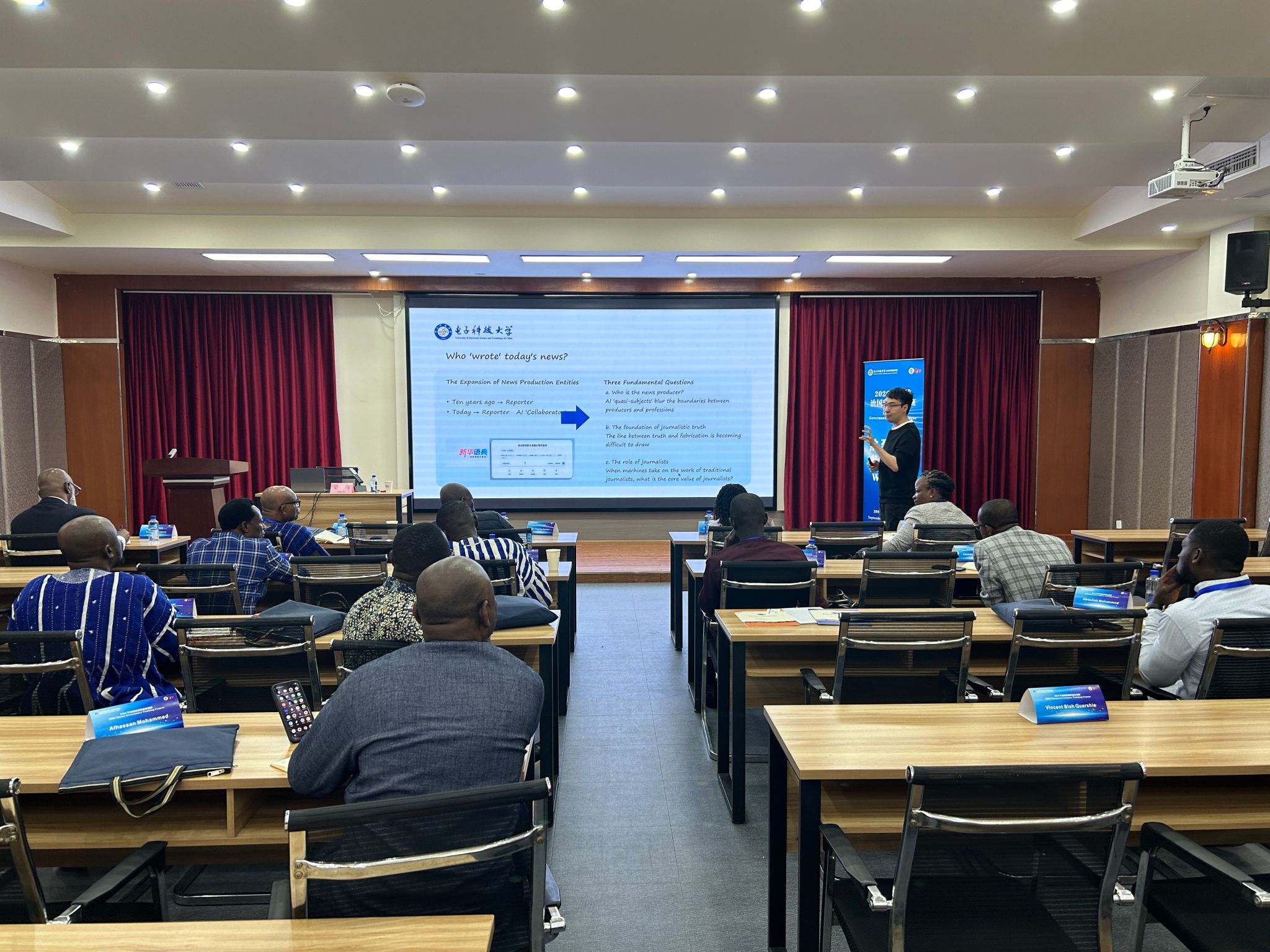
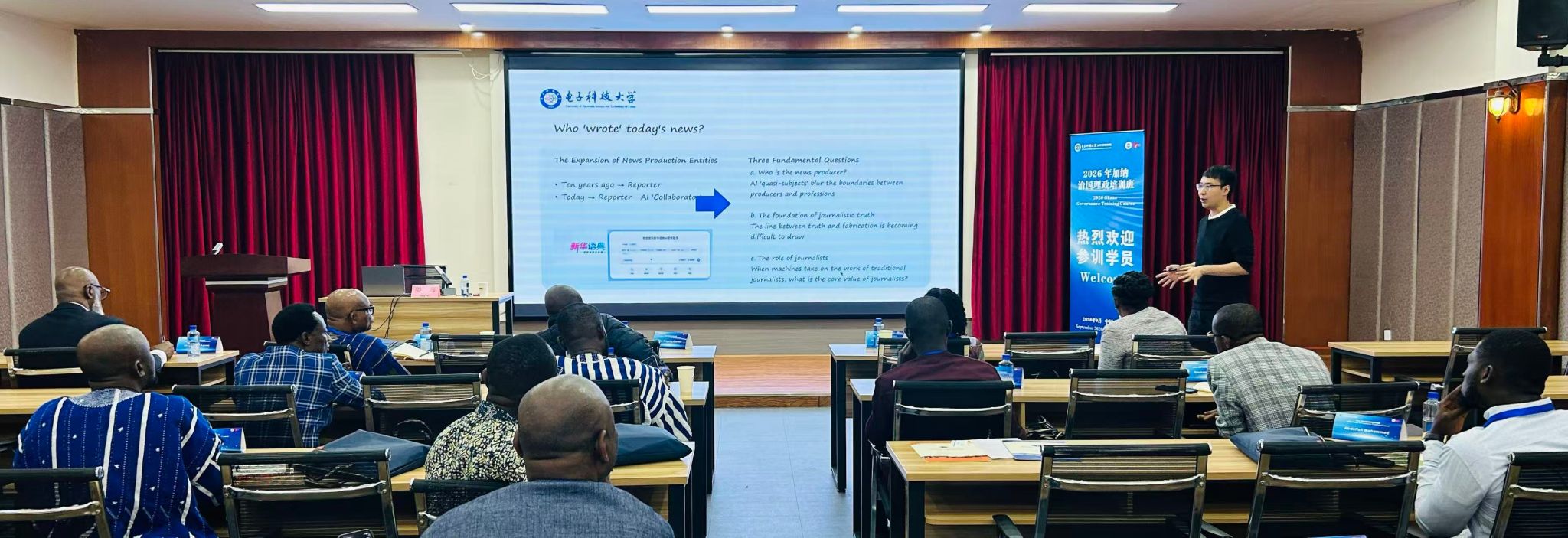
Teaching by Prof. Jiang in the classroom
During classroom teaching, Jiang Hai started with the question “Who is writing news today?”. He pointed out that with the
involvement of AI, the subjects of news production have expanded from traditional journalists to “journalists plus AI
collaborators”. As a “quasi-subject”, AI blurs the boundaries of industrial production and brings new challenges to news
authenticity and the roles of journalism practitioners. Drawing on classic theories such as sociology of news production,
human-machine symbiosis and augmented human intelligence, he proposed that human-machine collaborative news production should
adhere to human leadership, AI assistance and flexible division of labour throughout the whole process.
The course reviewed the evolution of AI news production in China since 2015 and cited domestic practical cases such as the
intelligent production platform of Xinhua News Agency. Meanwhile, it made international comparisons and introduced explorations
by overseas media including Reuters, BBC and Associated Press. He stated that “Human-Machine Collaboration” has become a global consensus
in the media industry. Structured data processing can be assigned to algorithms, but value judgment, ethical bottom lines and
final content checks must be firmly undertaken by humans. Human-machine collaboration does not weaken the role of humans;
instead, it reaffirms human subject value in the new technological environment.
After the lecture, Jiang Hai had in-depth interactive exchanges with Ghanaian participants on practical issues of public
administration and urban-rural development. During the training, participants also went to community governance sites in
Chenghua District, Zhanqi Village and Qinggangshu Village for field research, integrating classroom theoretical teaching and
on-site observation and learning.
This course falls under the “Digital Smart Governance” module of the training programme. It serves as a vivid practice for
mutual learning and exchange of governance experience within the framework of the China-Africa Year of People-to-People and
Cultural Exchanges. Although the training programme has concluded, dialogue and exchanges between China and Ghana in the fields
of digital governance, public administration and urban-rural development will continue.
Text by CWAS team
Photos by Xupeifeng, Luohongquan
Edited by Zhangruiheng
Contributed by: School of Public Administration & Center for West African Studies of UESTC, University of Electronic Scienceand Technology of China





 Address:Qingshui River Campus: No. 2006 West source road, Chengdu high tech Zone (West District)
 Code: 611731
 E-mail: cwasuestc@163.com
 Tel: 0086-028-61831756/61831706
 Fax: 0086-028-61831756/61831706