[Editor's Note] 2026 marks the 70th anniversary of the establishment of diplomatic relations between China and Africa, as well as the "China-Africa Year of People-to-People and Cultural Exchanges." The 2026 Ghana Governance Training Programme is one of the 2026 China-Africa people-to-people and cultural exchange events held by the Center for West African Studies of the University of Electronic Science and Technology of China (UESTC). Co-organized by the Center for West African Studies of UESTC and the UESTC Base for Sichuan Provincial Cadre Education and Training, the programme targets participants from Ghanaian universities and local public administration authorities. It offers a series of special lectures to share China's practical experience in governance, promote mutual learning between China and Ghana, and deepen China-Africa people-to-people and cultural exchanges. The programme brings together experts and scholars from across the university, offering multi-dimensional professional insights for Ghanaian participants.
From September 24 to October 2, the 2026 Ghana Governance Training Programme was held at the Shahe Campus of UESTC. Following the spirit of President Xi Jinping's congratulatory letter to the opening ceremony of the 2026 China-Africa Year of People-to-People and Cultural Exchanges, the programme offered special courses focused on digital smart governance. The programme invited Professor Dong Ziming from the School of Public Administration at UESTC to teach the course "Digital Nudging and Grassroots Governance: Small Interventions, Big Changes." Addressing Ghanaian government officials, university scholars, and media executives, the course systematically explained the theoretical lineage of nudge theory, the governance application scenarios of digital nudging, and China's grassroots governance practices, providing case references for developing countries to achieve "big changes" through "small interventions."
Dong Ziming holds a PhD in Literature from Sichuan University and was a visiting scholar at the East Asian Institute of Columbia University in the United States. She is Director of the Digital Culture and Media Research Base (a key research center for philosophy and social sciences in Sichuan Province) at UESTC, and has long focused on digital public governance, public opinion studies, and social communication research. She has presided over more than ten research projects, including National Social Science Fund projects and provincial- and ministerial-level projects; published three academic monographs and 47 papers, 34 of which appear in CSSCI-indexed journals, with several fully reprinted in Renmin University of China's Reprinted Newspaper and Periodical Materials and excerpted in Xinhua Digest. She is a recipient of the First Prize of the 7th Outstanding Achievement Award for Humanities and Social Sciences Research in Chinese Higher Education Institutions (Ministry of Education) and the First Prize of the Sichuan Provincial Outstanding Achievement Award for Philosophy and Social Sciences, and was named a Top 1% Highly Influential Scholar on CNKI (China National Knowledge Infrastructure) for 2024 and 2025. She has developed an assessment model for public opinion analysis that has served decision-making in Party and government departments in multiple localities, co-founded the China-Africa International Academic Exchange and Talent Training Base, and co-hosted the second and third Forums on Communication and Social Development in the Himalayan Region in Kathmandu, Nepal.
Adopting a progressive teaching structure of "theoretical instruction—case analysis—interactive discussion—boundary reflection," the course comprised several modules covering theoretical origins, the nudge toolbox, a window on Chinese practice, and ethical reflection. The full session lasted about two and a half hours, balancing academic depth with classroom interaction.
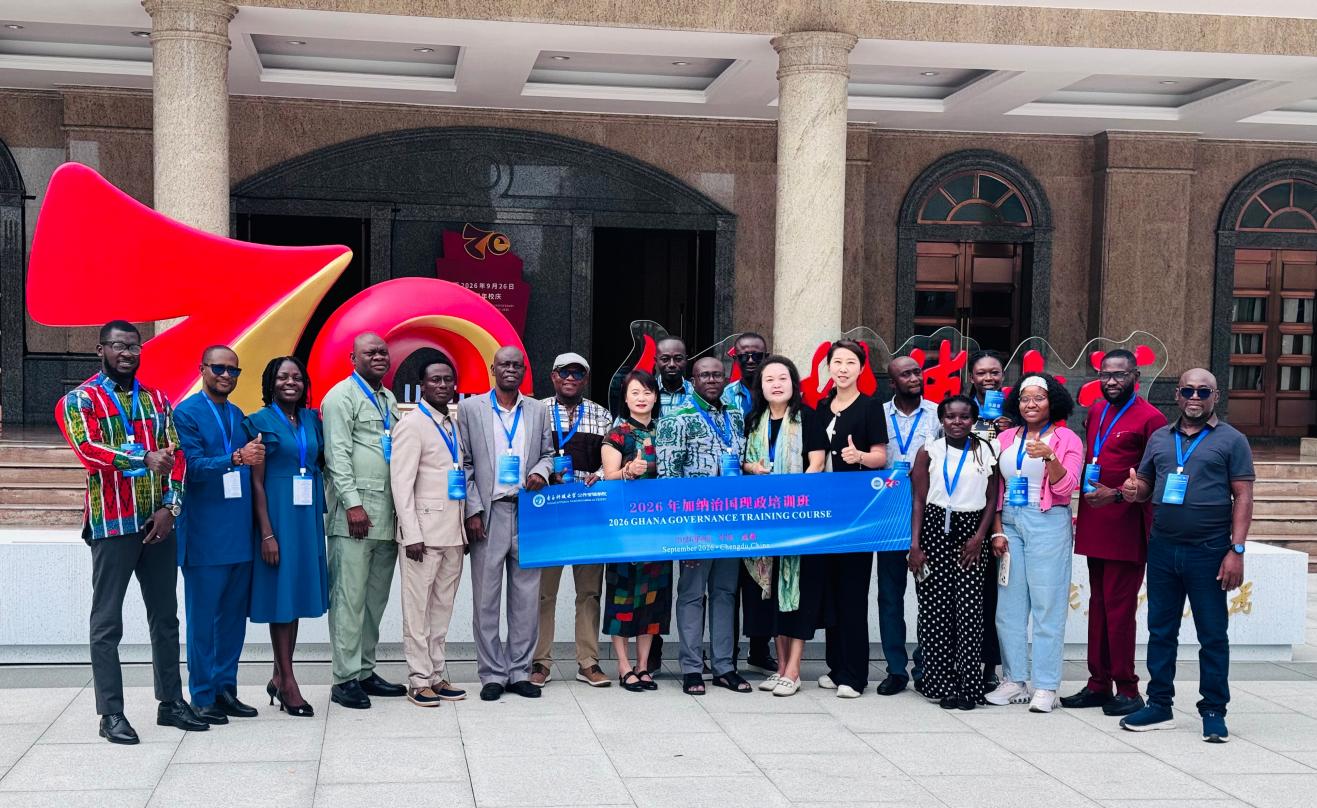
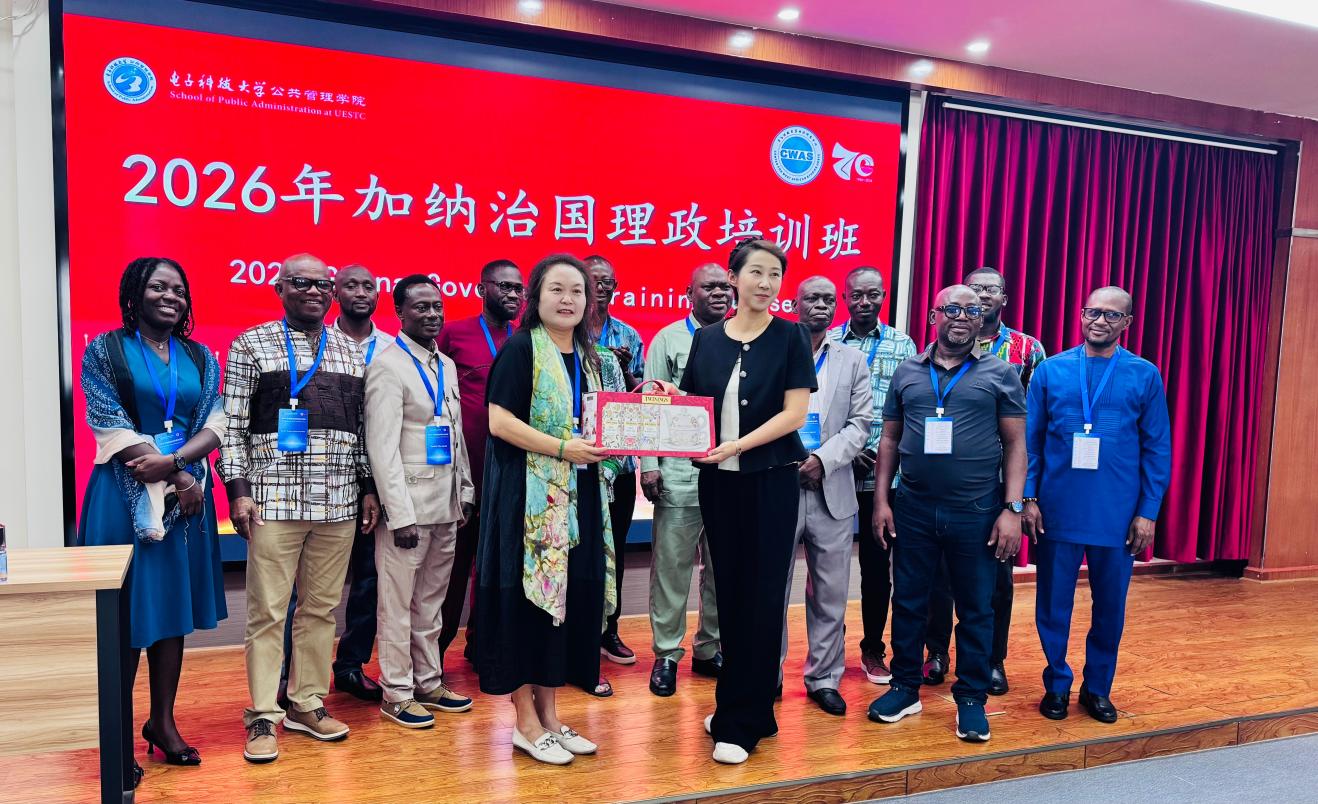
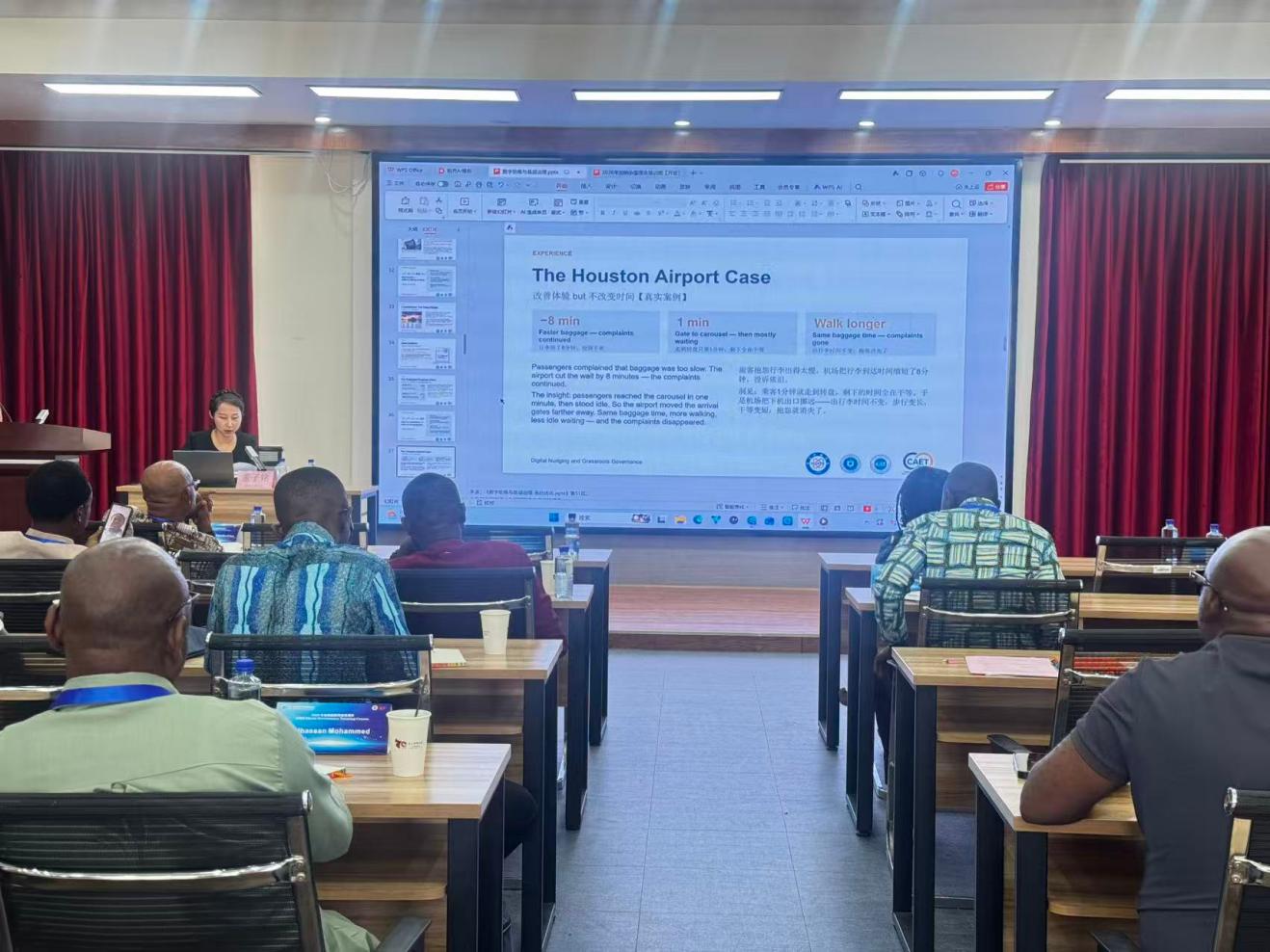
Teaching by Prof. Dong in the classroom
The course reviewed the theoretical origins of nudge theory developed by Richard Thaler and Cass Sunstein, explained the five dimensions of the nudge toolbox, and extended the discussion from "offline nudging" to "digital nudging": default options, smart push notifications, and social norm cues allow small behavioral prompts to be scaled up in digital spaces at low cost. In the module "Media Itself as a Nudge," Professor Dong explained the communication principles behind framing effects and emotional priming, highlighted the connections between newspaper front pages and "default options," mobile push notifications and "gentle reminders," and trending search rankings and "social norms," and clarified the boundary between persuasion and nudging. Focusing on nudge mechanisms in media operations, Ghanaian media executives and government officials exchanged views in light of their own communication practices, and held in-depth discussions with the lecturer on topics such as how public information can effectively reach the public.
This course belongs to the "Digital Smart Governance" teaching module of the programme, integrating China's grassroots governance and communication innovation experience with the governance realities of African countries. Although the training has concluded, the exchanges and dialogue between the two sides on digital governance and grassroots governance will continue to deepen.
Text by CWAS team
Photos by Xupeifeng, Luohongquan
Edited by Zhangruiheng
Contributed by: School of Public Administration & Center for West African Studies of UESTC, University of Electronic Scienceand Technology of China






 Address:Qingshui River Campus: No. 2006 West source road, Chengdu high tech Zone (West District)
 Code: 611731
 E-mail: cwasuestc@163.com
 Tel: 0086-028-61831756/61831706
 Fax: 0086-028-61831756/61831706