Editor's Note: The year 2026 marks the 70th anniversary of China‑Africa diplomatic relations and the "China‑Africa Year of Cultural and People‑to‑People Exchanges". The 2026 Ghana Governance Training Programme is one of the 2026 China‑Africa people‑to‑people exchange series organised by the Center for West African Studies of UESTC. Co‑hosted by the Center for West African Studies of UESTC and the Sichuan Provincial Cadre Training Base at UESTC, this training programme targets participants from Ghana’s universities and local public‑administration authorities. It offers thematic courses to share China’s practical experience in national governance, advance mutual learning between China and Ghana, and deepen China‑Africa people‑to‑people exchanges. A host of experts and scholars from UESTC are invited to give lectures and deliver multi‑dimensional professional insights to Ghanaian participants.
Held at the Shahe Campus of UESTC from 24 September to 2 October 2026, the 2026 Ghana Governance Training Programme aligns with the spirit of President Xi Jinping's congratulatory letter to the opening ceremony of the 2026 "China‑Africa Year of Cultural and People‑to‑People Exchanges", and features a series of sessions on governance‑experience exchange. Professor Pan Na was invited as a guest speaker. She works at the School of Urban Economics and Public Administration, Capital University of Economics and Business, and serves as Executive Director of its MPA Education Centre. Holding a Doctorate in Public Administration from Renmin University of China and completing her post‑doctoral research at the Chinese Academy of Personnel Science, Professor Pan Na presides over youth, general and key projects funded by the National Social Science Fund of China. She has published more than 30 academic papers in Chinese and English. Her honours include the Excellent Teacher Award of the National MPA Steering Committee (2021) and Outstanding Young Talent under the 2023 Beijing Municipal University Faculty Development Programme. She also holds concurrent positions as Deputy Director of the High‑end Capital Think‑Tank for Mega‑city Economic and Social Development, Council Member of the China Society of Administrative Reform, and special researcher at the Beijing International Volunteer Service Base.
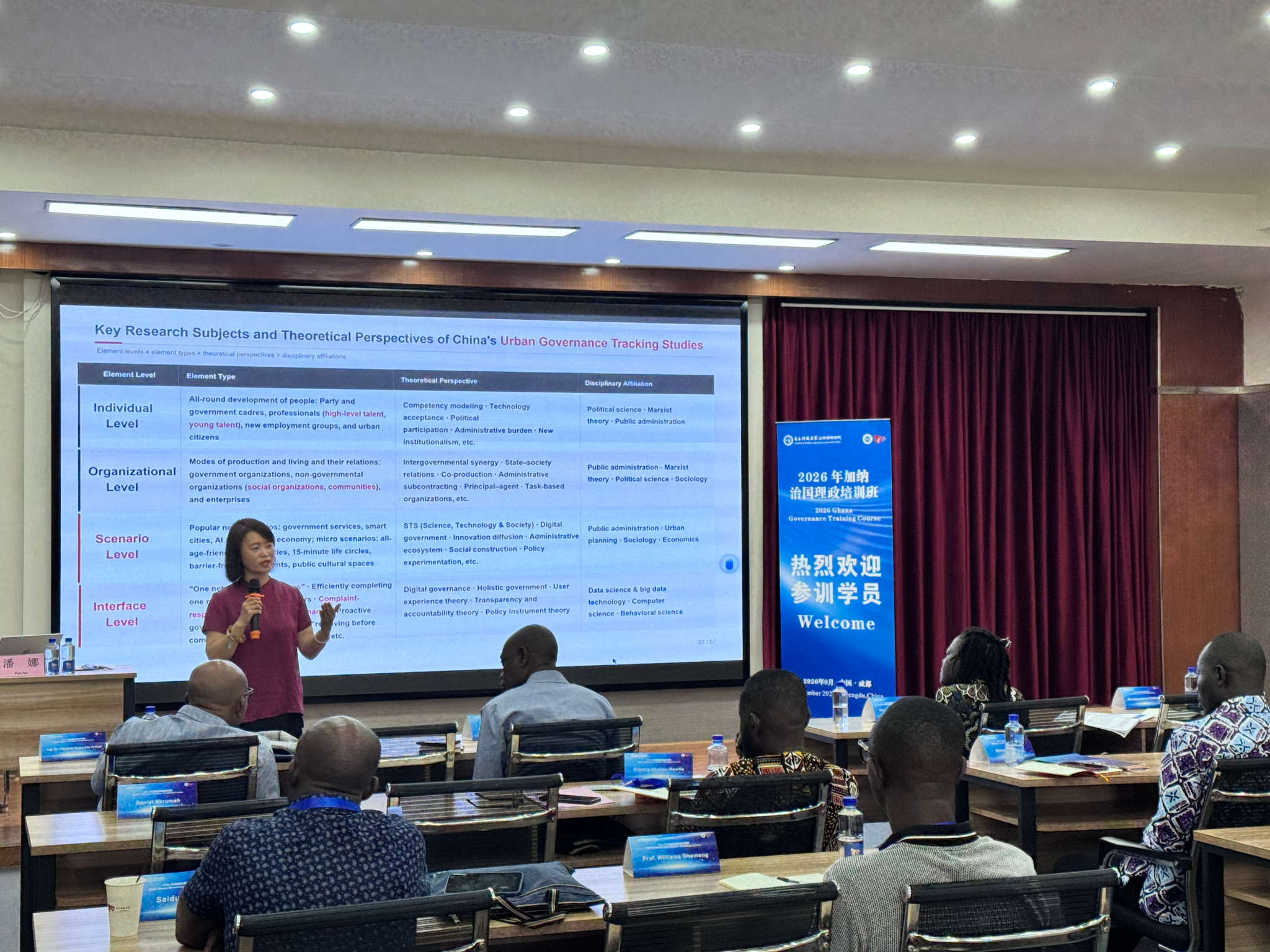
Centred on the overarching theme "Urban Governance and Innovative Practice in the Era of Digital Intelligence", her lectures cover three modules: "Interfaces and Scenarios", "Value Restructuring and Institutional Adaptation", and "Technology Transition and Case Discussions". Opening with the symbiotic proposition "Us and Cities: From Cradle to Grave", Professor Pan Na reviewed front‑line developments, challenges and prospects of modern urbanisation, prompting participants to reflect on the necessity of urban‑governance innovation in the VUCA era. Drawing on real‑world cases including the "Feng Xiao‑Zhi" digital assistant in Beijing Fengtai District, 70 AI‑empowered civil servants in Futian District of Shenzhen, human‑machine collaborative grassroots governance powered by social‑work large models, and the "123X" IoT big‑data smart platform for urban public administration, she systematically illustrated how digital‑intelligent technologies evolve from instrumental empowerment toward systemic reconstruction. She argued that digital public governance should reconcile the triple logics of "value‑technology‑institution", span four levels: "individual‑organisation‑scenario‑interface", and build a holistic analytical framework linking macro‑institutional structures and micro‑actor strategies by identifying the common ground between individual rights and collective well‑being. She stressed that technological applications in urban‑governance innovation must be anchored in people‑centred values. The 12345 public‑service hotline, which connects a mega‑city with millions of residents, serves as a vivid embodiment of the principle that "cities are built by the people and for the people".
In the session "Value Restructuring and Institutional Adaptation", Professor Pan Na unpacked the people‑centred core of "people‑oriented cities": transcending capital‑driven logic and pursuing spatial justice and equal rights. Focusing on citizen interactions with digital government services in the digital‑intelligence age, she analysed the causes of citizen administrative burdens brought by digital formalism and corresponding solutions. Referencing the landmark achievement that China entered the world's top 10 in the 2025 Global Innovation Index, she summarised systematic actions behind China's governance innovations: advancing regional integration through urban agglomerations and metropolitan areas, fostering vibrant innovation ecosystems, implementing smart‑city strategies, and delivering people‑first public services.
Turning to the global issue of regional governance, she took the coordinated development of the Beijing‑Tianjin‑Hebei region as an example and outlined its evolutionary path: "project‑initiated relations → leader‑driven cooperation → institutionalised organisational ties → stable cooperation underpinned by formal institutions". She presented China's approach to cross‑border governance across eight dimensions: strengthening legal frameworks, building multi‑level organisational systems, setting‑up regional cooperation funds, improving performance evaluation and accountability, refining benefit‑coordination and ecological‑compensation mechanisms, promoting information sharing, establishing regional credit systems, and boosting cross‑regional talent development. Using inter‑provincial games over river‑basin ecological compensation as a teaching example, she vividly demonstrated how the principle "upstream protection, downstream compensation" can shift actors from short‑term individual rationality toward long‑term collective win‑win outcomes, which resonated deeply with participants.
Case‑based teaching stood out as a highlight of her series of lectures. Professor Pan Na selected three progressive Chinese cases: the "One‑Click Rescue" system in Hangzhou — the origin of the City Brain project, which unpacked organisational secrets for cross‑departmental collaborative innovation; the Beijing Daxing Hydrogen Energy Demonstration Zone, which went "from zero to scale" and completed decision‑making, planning, construction and ecosystem cultivation within 14 months; applying the Institutional Analysis and Development (IAD) framework to decode governance synergy behind the "Daxing speed"; and the "Academic‑style Neighbourhood" in Xincun Sub‑district, Fengtai District of Beijing, illustrating how university‑neighbourhood partnerships realise integrated development of campuses, industrial parks and communities through value co‑creation. She guided participants to conduct group discussions against the mandate of Ghana Free Zones Authority and planning practice of the Afienya Special Economic Zone. Participants addressed the question: "If you have 90 days to improve project delivery in an industrial park, which coordination bottleneck should you resolve as top priority?" Such dialogues enabled Chinese experience to generate insights adapted to African contexts.

After the lecture, Professor Pan Na held in‑depth exchanges with Ghanaian participants on shared topics including urbanisation and talent strategies. This course belongs to the "Digital‑Smart Governance" module of the training programme. It represents a lively practice of mutual learning on governance within the framework of the China‑Africa Year of Cultural and People‑to‑People Exchanges. From the "Chinese brain" of smart cities down to the "nerve endings" of neighbourhood‑level governance; from grand narratives of regional coordination to people‑oriented outcomes enabled by the "One‑Click Rescue" system, Professor Pan Na's lectures painted a picture of modern urban governance in the digital era. Although the training has concluded, China‑Ghana exchanges on digital governance, public administration and urban development will continue. The seeds of China‑Africa friendship and cooperation will take root, sprout and bear fruit on the fertile ground of training and exchanges.
Text by CWAS team
Photos by Xupeifeng, Luohongquan
Edited by Song He
Contributed by: Center for West African Studies of UESTC, University of Electronic Scienceand Technology of China






 Address:Qingshui River Campus: No. 2006 West source road, Chengdu high tech Zone (West District)
 Code: 611731
 E-mail: cwasuestc@163.com
 Tel: 0086-028-61831756/61831706
 Fax: 0086-028-61831756/61831706